Virtual Card
After ChatGPT’s Work mode was launched, Tokens were consumed faster.
This past weekend, many people were waiting for the ChatGPT/Codex quota to be reset. OpenAI’s technical leader Tibo is jokingly called the “Godfather of Credit Reset” by our Vibe friends in the Mowen Vibe group – everyone talks about it so diligently that it is estimated that he can lift the roof if he sneezes.
On Saturday, he finally sent a message:
“We have reset usage limits for all Codex and ChatGPT Work users. We experienced a near-global service outage last night at approximately 2-4am. It’s fully restored now, but you know what’s coming. We learn from it, we reset limits, enjoy.”
At the same time, I also noticed a number: the combined number of active users of Codex and ChatGPT Work has exceeded 10 million.
Why is he called the “Godfather of Credit Reset”? Because of the matter of resetting the quota, he was indeed very skilled at it. For many users, usage quota has become a resource that must be carefully calculated every day; and a reset itself is like a hacker growth activity, which is estimated to bring back hundreds of thousands of users. 😂
But after the Work mode entered the scene, everyone consumed more Tokens, and new questions also emerged: What exactly is Work? What is the difference between it and Codex?
I saw many foreign users leaving comments directly under Tibo’s post: “I actually don’t understand the difference. The interface still looks the same. I use Work, not Codex, and I haven’t noticed any changes.” Some people asked: “What is the difference between Work and ordinary GPT? What extra does it provide?”
Background: Why is the boundary between Work mode and Codex attracting attention?
Let’s talk about the picture first.
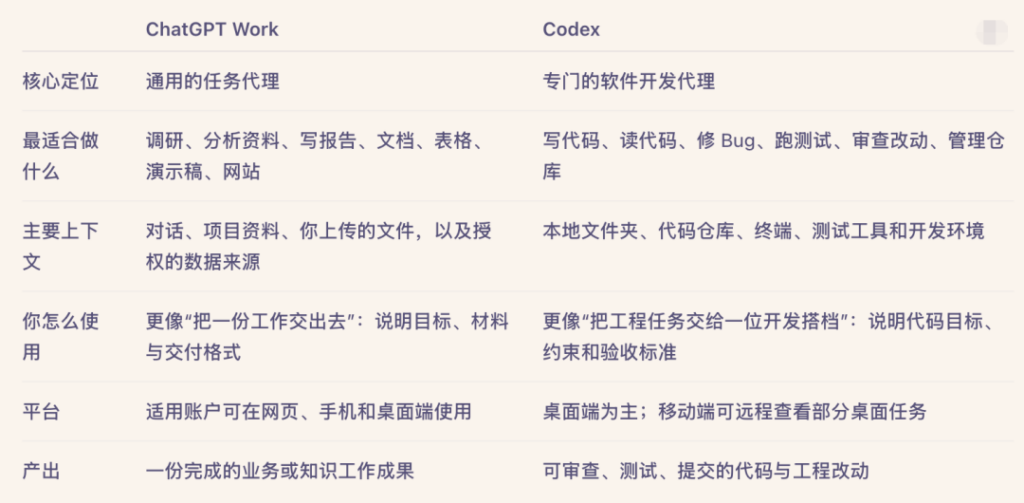
There are actually many products in China that differentiate between Code and Work, such as TRAE Work, WorkBuddy, etc. The overall rules and function distribution are pretty much the same, but I personally feel that domestic products have a clearer division of responsibilities.
In the past, the core of ChatGPT was Chat: you and I communicate, ask questions, and answer questions. When it comes to Work, the basic unit becomes Task, which is “task”. In a session, one or more tasks can be completed.
You can make it:
“Compile these interviews into a report, give three key conclusions, and then make a presentation suitable for management.”
You can also make it:
“Organize download folders, categorize them by project and file type, and list duplicate files.”
Make a website that can be used directly online, send and receive emails, write reports, make slides… these can all be handed over to Work.
To put it simply, Work can be used to do anything that is not directly related to software development. What it adds is essentially a layer of task running mechanism: receiving longer tasks, connecting to more office-related plug-ins, retaining project context, operating files, and continuing to advance over a period of time, and finally handing over documents, forms, reports, presentations and even websites as deliverables.
Codex focuses on software development. The UI and functional design are also different from Work, and the boundaries are relatively clear.
Codex faces code warehouses, directory structures, dependencies, terminal commands, test results, Git changes and deployment environments. A typical task might be:
“A white screen occasionally appears on this page. Please locate the cause, fix it and then test it, and explain the risks of the change.”
It can enter local folders and repositories, use the terminal and development tools, run tests and commands, inspect changes, and retain context during complex tasks. For developers, the ultimate concern is not “whether the answer is correct or not”, but whether the code is correct, whether the test can be passed, and whether it can be successfully launched in the end.
Pain point: Why are ordinary users easily confused between Work and Codex?
Because this design is indeed a bit stretched.
There are two obvious problems:
- Many tasks in Work can also be done in Codex, but you just need to connect those plug-ins yourself.
- When I switch between Work and Codex in the same session, there is almost no clear perception. In the end, I didn’t even know which mode I was working in.
Claude does this a little better, and its sessions differentiate more clearly between modes.
So, in actual use, it becomes: if you are an engineer or Viber, then always open Codex; if you are a knowledge worker and basically do not touch development, then always open Work.
Is this a good design? I don’t think so.
Since Claude launched Cowork, more and more products have begun to follow this idea: switching working modes through tabs. But after users actually enter the product, what they often get is not a clear division of labor, but more confusion.
As far as my own experience is concerned, most tasks in Work mode are completed in the sandbox; Codex can break out of the sandbox, or simply operate the command line, process files and data directly in the local environment. It is stronger and more dangerous, and the requirements for users are naturally higher.
Current situation: AI products are dividing dialogue, office and development tasks
This year many domestic and foreign products are developing in the direction of “Work”.
TRAE upgraded SOLO, which was originally focused on autonomous programming agents, to TRAE Work, describing it as a workspace for research, writing, data analysis, planning and collaboration; while retaining the Code mode for developers and the Design mode for designers.
Tencent’s WorkBuddy positions itself as an AI workbench for the workplace, emphasizing multi-step tasks, file and data processing, content production and multi-agent collaboration.
Why?
Because after AI vendors collect subscription fees from high-net-worth users through Code Agent, they still need to continue to grow. The group of people that is larger than developers are knowledge workers – which is obviously more than 10 million paying users.
I think this is why Work is more flexible than Codex.
Solution: Combine Work and Codex by task type
For example, if a product manager wants to create a new feature, he can first organize user feedback, study competing products, and formulate a requirement description in Work; then hand over the clear implementation tasks to Codex to complete code modification, testing, and review.
An operations team can let Work aggregate data and generate plans, and then the engineering team uses Codex to connect the automated process into the system.
Therefore, Work is not a simple new feature. It is more like the product of large model capabilities re-divided according to scenarios: Chat is responsible for dialogue and search, Work handles general knowledge-based long tasks, and Codex goes deep into engineering systems and does software development.
It’s just that this division always makes me feel a little awkward. It’s more like a forced feature cut, so users will be confused and so will I.
But Agent is developing quickly. Maybe after a while, these modes will be re-integrated and scenario-based will become invisible – that may be a more advanced product design.
Virtual Card
Original article by Virtual Card Reviews & Cross-Border Payment Guides. If republishing, credit the source: https://visaspay.com/en/this-weekend-many-people-are-waiting-for-a-quota-reset-and-they-also-compla/