Virtual Card
Data verification time: September 28, 2026. This article reviews the GPT-5.6 efficiency and pricing updates announced by OpenAI on July 29-30, 2026. Figures such as “price reduction” and “nearly 9 times” in the article belong to the specific comparison caliber stated in the official announcement and do not mean that every API request can obtain the same speed, quality or billing results; please refer to the official page for actual prices and functions.
Background: Why does GPT-5.6 talk about price reduction and speed increase at the same time?
For individual developers and enterprises, model capabilities are only half of the selection process: if each call is expensive, or the response time is not suitable for the business process, no matter how powerful the model is, it may not be able to be implemented on a large scale. OpenAI announced on July 30, 2026 that it would lower the API prices of GPT-5.6 Luna and Terra, and launch Fast mode for the GPT-5.6 Sol API, trying to cover high-frequency, daily and more latency-sensitive work respectively.
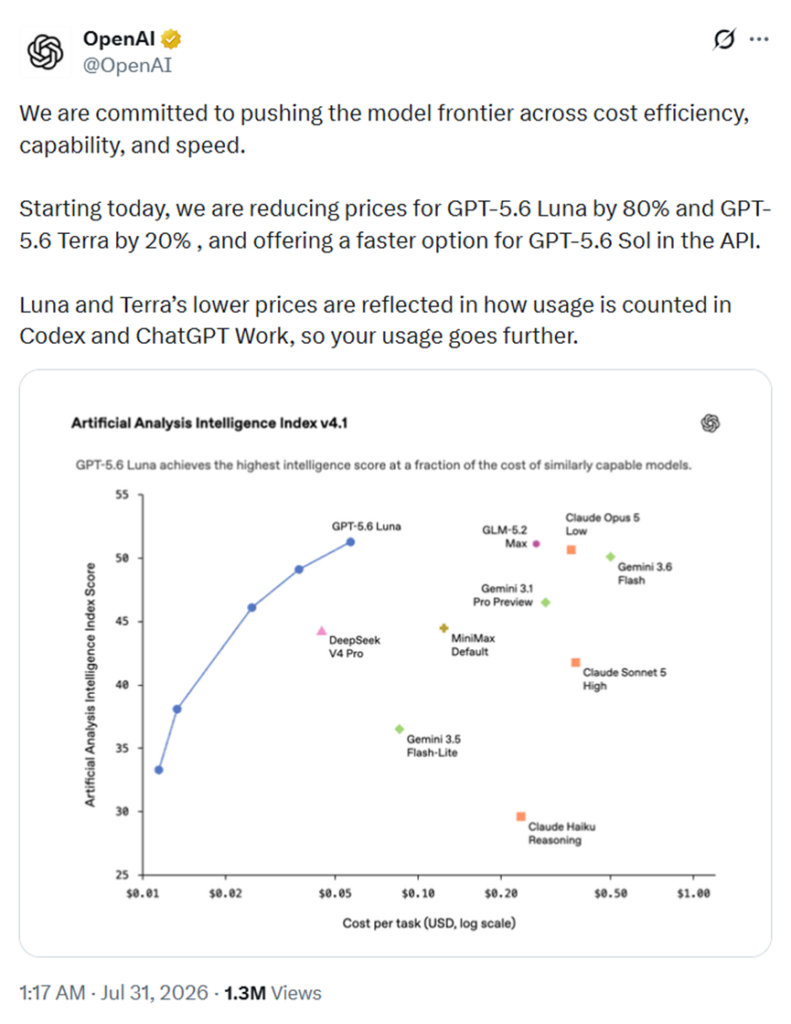
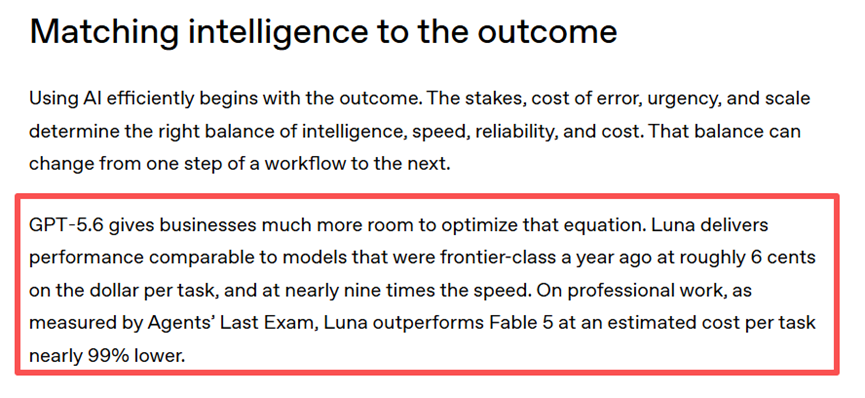
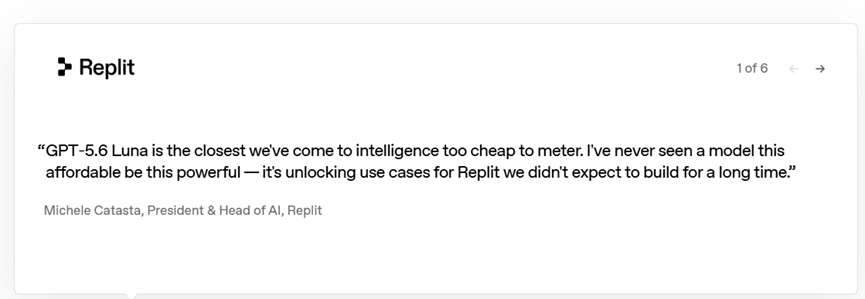
OpenAI made a task-level comparison between Luna and the cutting-edge model from a year ago: its statement is that Luna is close to the cutting-edge level at the time in relevant professional work performance, with an estimated single-task cost of approximately 6% of the original and nearly 9 times faster. In the professional work evaluation of Agents’ Last Exam, OpenAI reports that Luna is better than Fable 5, with an estimated single-task cost that is nearly 99% lower. These are official results based on specific tasks, evaluations and cost estimates. They are not independent full-scenario horizontal tests, nor can they be directly converted into a speedup ratio for each user request.
Pain point: Even if the price tag is lower, why might the actual cost still exceed the budget?
API billing is not only determined by the “unit price per million tokens”. Input and output lengths, cache hits, long contexts, tool calls, number of retries, and whether the task can be completed in one go can all change the final payout. Testing with just a short prompt or looking at a price list can easily underestimate the true cost in a production environment.
The speed number also depends on the caliber. What OpenAI says about Luna is “nearly 9 times” is a task-level comparison with cutting-edge models a year ago; Sol Fast mode’s “up to 2.5 times” is the official upper limit relative to Sol’s standard processing. The comparison objects between the two are different. It cannot be understood that every generation of Luna is 9 times faster than the old model, nor can it be guaranteed that every request in Fast mode is 2.5 times faster.
Current situation: model optimization, API price and the boundary of Fast mode
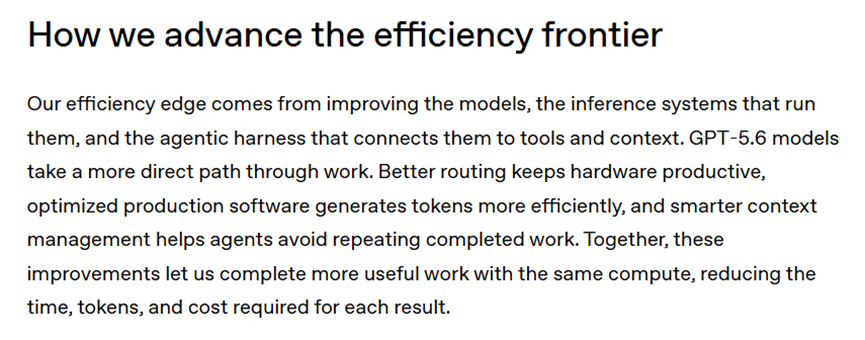
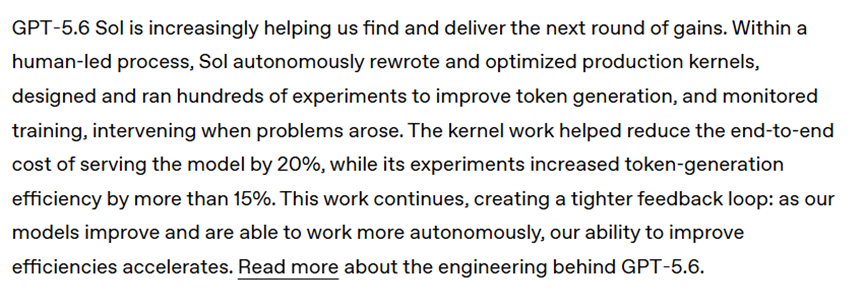
OpenAI attributes this round of efficiency improvements to multi-layer optimizations such as models, inference services and workflows. The official project description mentions that GPT-5.6 Sol participates in improving the production GPU kernel, and related optimizations reduce end-to-end service costs by about 20%; inference scheduling, caching, and speculative decoding are also among the efficiency directions introduced. Server-side cost changes are not the same indicator as the API price reduction of a certain model, and it cannot be deduced that each user can save the same proportion.
According to OpenAI’s announcement on July 30, 2026, Luna’s API standard price is adjusted to US$0.20 per million input tokens and US$1.20 per million output tokens; Terra’s input is US$2 and output is US$12. Sol’s Fast mode is up to 2.5x faster than standard processing, but costs twice the standard price. Fast mode is suitable for API requests where response time is really important. It is not equivalent to an upgrade of model capabilities, nor does it mean that all work is worth paying the premium.
Also note that prices will continue to change: OpenAI’s API documentation currently lists the standard price for Sol at $4 per million input tokens and $20 per million outputs, and notes that this promotional price applies until at least November 21, 2026. Corresponding models, processing modes, caching and long context rules should be reviewed before billing; do not treat the July Luna/Terra price announcement as Sol’s current price.
Refer to official information:GPT-5.6 Price and Performance Announcement、GPT-5.6 Engineering Efficiency Description、Fast mode instructions for use and GPT-5.6 Sol model and price.
Solution: Make a small-scale comparison with real tasks, and then decide whether to migrate
First select several representative tasks from the actual workflow, such as classification, summary, code assistance or multi-step agent tasks. Use the same input samples, acceptance criteria and concurrency conditions to record the success rate, manual rework, response time, token usage and actual bills respectively; also note the cache status, context length and tool calls to avoid mistaking differences in test conditions for model advantages.
- High-frequency, clear-bounded steps: Evaluate Luna first, focusing on whether the quality is up to standard and the total call cost, not just the unit price.
- Common tasks where quality and cost need to be balanced: Test Terra against controls and reserve costs for error rates or manual review.
- For API processes with high response time requirements: test Sol standard mode first, and then test Fast mode; retain the premium only when the saved waiting time has clear value to the business.
If you still want to use a payment card to pay for API or other overseas services, you should first check the regions, billing information and card rules currently supported by the service provider; virtual cards are not guaranteed to be accepted by every platform, nor can they replace budget caps, usage alarms and key management. The final selection is best determined by the quality threshold, latency requirements and acceptable monthly budget, and then gradually expand the traffic.
Virtual Card
Original article by Virtual Card Reviews & Cross-Border Payment Guides. If republishing, credit the source: https://visaspay.com/en/gpt-5-6-luna-price-reduced-by-80-task-level-speed-nearly-9-times-how-to-cho/