Virtual Card
Let me explain first:“The first to use Codex to make TikTok” in the title is the author’s judgment of a working method and does not point to a verified personal case. This article discusses how to use AI for content planning, data organization, and review; Codex is not equal to TikTok’s official publishing tool. Whether it can connect to external services depends on specific integration and authorization, and there is no guarantee of playback volume or inquiries.

Background: Why cross-border businesses should use TikTok as a long-term content channel
For foreign trade factories, brands and cross-border sellers, short videos can help potential customers see the product, production process and team before deciding whether to learn more. But “sending a video” does not mean “having a customer”: from being seen to generating trust, to homepage visits, private messages, inquiries and closing transactions, continuous, credible and acceptable content is required in the middle.
Many teams do not lack product knowledge. What they lack is the method of stabilizing knowledge into topic selection, scripts, shooting materials and follow-up. TikTok’s official creative recommendations for small businesses also emphasize continuous release and testing iterations; such recommendations are operational directions and do not mean that any account can achieve the same results.TikTok for Business: Creative Strategies for Small Businesses

Pain point: I posted a lot of videos, but my experience and customer leads were not retained.
If the topic selection relies on temporary inspiration, the script relies on improvisation, the materials are scattered on employees’ mobile phones, and the performance is not recorded after publishing, then each video will be like starting from scratch. Occasionally, the playback volume is good, but it is difficult to answer: What kind of customers stopped to watch? What do they care about? What should be reused or improved next?
- The product selling points do not correspond to specific customers and usage scenarios;
- There is no clear division of labor in shooting, editing and review, and content output is fast and slow;
- Playback, comments, homepage visits, private messages and inquiries are scattered separately, and the links cannot be reviewed;
- Worry that the AI will write the wrong parameters, certification, price or delivery date, but dare not use it for work.
What really makes the team tired is not “not being able to write a sentence of script”, but repeatedly looking for information, aligning information, and urging materials every day, without accumulating experience that can be reused in the next round.
Current situation: The problem is not just the output, but the disconnection between the content and the inquiry
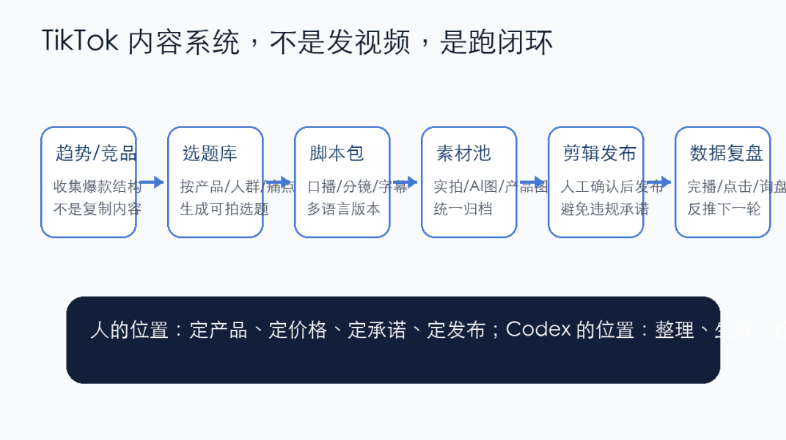
Many teams regard “posting a few posts per week” as their main goal, but do not clarify what each piece of content serves: displaying products, explaining processes, answering purchasing concerns, or guiding customers for further consultation. The result is that the videos are independent of each other, the homepage is unclear, and there is no stable follow-up method for private messages.
The more executable link is:Target customer issues → Topic selection → Script and materials → Filming review → Release → Home page/private message acceptance → Record clues → Review. AI can assist in organizing and generating drafts, but whether the business information is accurate, whether the content is suitable for publication, and how to handle customer leads still require team judgment.
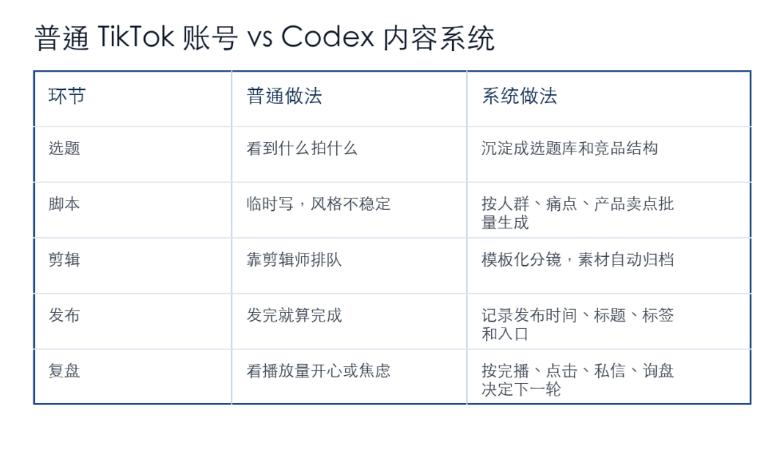
Therefore, instead of asking Codex to generate 100 scripts at once, it is better to give it clear and credible business information and goals, and then let it help you break the process into small tasks that can be checked.
Solution: Let AI speed up repetitive work and put people in charge of facts and business judgments
First create six types of maintainable data
- Product library: Specifications, real selling points, usage scenarios, displayable content and prohibited commitments.
- Customer library: Target customer types, markets, purchasing roles and the first questions they usually ask.
- Pain point library: Real concerns such as price, quality, delivery time, certification, after-sales or supply stability, etc., and indicate which ones can provide evidence.
- Competitor Observation Database: Record the beginning, expression and comment questions of the public content, learn the structure, and do not copy the copy or material.
- Script and material library: Classify by oral broadcast, real shooting, comparison, factory display, cases and usage scenarios, and mark the material authorization and usable scope.
- Review library: Record release date, content topics, views and interactions, homepage visits, effective private messages and inquiry quality, combined with target evaluation.
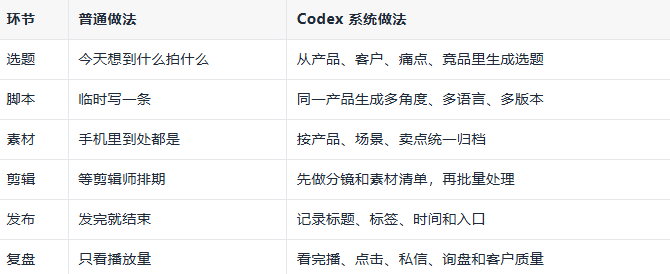
Clearly distinguish between AI work and manual review
Codex can help organize existing data into topic lists, first drafts of scripts, storyboards, release calendars or review templates; if real data is provided, it can also help summarize common problems and content performance. Teams should still manually check product specifications, prices, certifications, inventory, delivery dates, promotional compliance, and customer responses. When involving customer personal information or undisclosed business information, you should also first confirm the company’s authorization and the data processing requirements of the tool, and do not directly insert sensitive information into the prompt word.
Prompt words that can be used directly
Please be my cross-border short video content assistant. Help me build a weekly TikTok content plan based only on the product information, target customers, available materials and historical data I provided. Please output: target customer questions, topic selection, script draft, shot list, subtitle points, homepage acceptance suggestions and review fields. Don’t make up parameters, certifications, prices, inventory, delivery dates, customer cases, or performance data; ask questions when information is missing, and don’t guess. Any commitments, quotes, compliance conclusions, customer responses, and official releases are marked “Requires manual confirmation.” Please do not post, private message, or otherwise perform external actions.
Use seven days to complete one round first, don’t rush to pursue automation
- Day 1: Compile the real information, customer types and non-commitment boundaries of 10 main products.
- Day 2: Observe similar public accounts, record audience questions and content structure, and do not copy the original text or video.
- Day 3: Generate a batch of draft topic selections, and the business staff will screen out content that can be answered and photographed.
- Day 4: Write a script and shot list for the topic, and confirm who needs to provide what materials.
- Day 5: Focus on shooting products, processes, packaging or usage scenes; only use materials that you have the right to publish.
- Day 6: Edit and manually review facts, authorizations, and platform rules before publishing through an official team-approved process.
- Day 7: Record views, interactions, home page visits and valid inquiries, and discuss what to keep or adjust for the next round.
There is no need to regard the number of views as the only success or failure criterion at the beginning. It is more suitable to simultaneously observe whether the content is produced stably, whether the target customers understand it, whether there is high-quality interaction, and whether the team can handle the consultation. Different categories and markets have different conversion cycles, and short-term data cannot alone prove that a certain approach is necessarily effective.
The first person to use Codex to build TikTok “sees the long term”. What is truly worth learning from is not the pursuit of AI popularity, but the willingness to turn content from temporary tasks into business processes with data, review, and review. AI helps you save time on repeated sorting, while humans take care of authenticity, trust and customer relationships – this is a more secure approach that can accumulate in the long term.
Virtual Card
Original article by Virtual Card Reviews & Cross-Border Payment Guides. If republishing, credit the source: https://visaspay.com/en/the-first-person-to-use-codex-to-make-tiktok-really-saw-the-future/