Virtual Card
On the evening of July 22, many Facebook advertising optimizers encountered the same situation: the consumption data of the advertising account suddenly stopped updating, and the budget seemed to have pressed the pause button.
Starting around 10 p.m., advertisers reported one after another that the consumption figures in the Ads Manager backend did not move for a long time. Some accounts have almost no new expenses, while others are stuck with data from a few hours ago; if they are refreshed every hour, the numbers remain the same.
The anomaly began to appear roughly at 22:00 and lasted until the early morning of the next day. The feedback involves multiple accounts and different delivery areas. It is not like there is a problem with one account, one piece of material, or one market alone.
What the pitcher is most afraid of is not that the account is not consumed, but that he does not know whether it is “really not running” or “still running, but there is no return in the background.” virtual card
Background: This is more like a platform side anomaly than a single account issue
When the consumption of a single account slows down, several common reasons usually need to be looked at first: account quality, material fatigue, too narrow audience, too low bid, payment risk, abnormal landing page, or budget adjustment causing the system to relearn.
But this time the characteristics are different.
A large number of accounts experienced stagnant consumption at the same time in a similar period of time. The accounts themselves were in normal status, had sufficient budgets, and had no centralized adjustments to their materials and structures. This kind of synchronicity is more in line with the abnormal performance of the platform-side delivery system or data return link.
As of now, Meta has not issued an official statement on the situation on the evening of July 22. Some agent channels in the market mentioned that Meta may be making system adjustments in the near future, but this statement has not yet been officially confirmed.

Judging from the situation in the past week, the stability of the Meta advertising system is indeed not ideal.
According to public status records, on July 16, Meta confirmed that ad delivery was interrupted, lasting about 2 hours and 7 minutes, and was officially labeled as a high-level failure; on July 19, Facebook and Instagram also experienced large-scale access abnormalities, and login, content loading, and some ad management functions were affected, and they were restored after about 2.5 hours.
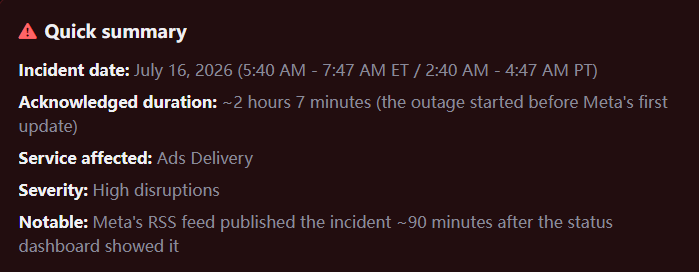
The continuous occurrence of system problems in a short period of time also makes this “no consumption” phenomenon particularly sensitive.
Of course, account trust, material quality and audience settings will still affect consumption. But these factors make it difficult to explain why multiple accounts collectively stalled at the same time.
Pain point: First determine whether the delivery has stopped or the data is not being returned.
When encountering this situation, the most common mistake is to rush to open the account.
When you see that you can’t consume enough, you cut the budget, turn off ads, change materials, and rebuild ad groups. As a result, after the platform was restored, the original stable structure was disrupted by itself. Especially for ad groups that are running well, there is no need to restart learning rashly just because of an abnormality of one or two hours. virtual card
My suggestion is to do cross-confirmation first to determine which layer the problem occurs on:
- Whether the consumption in Ads Manager stops updating;
- Whether there are new deductions in account bills and payment records;
- Whether independent station orders, Pixel events, GA or server-side data are still growing;
- Are there any changes in front-end data such as landing page visits, additional purchases, initiated checkouts, etc.;
- Do peers, agents and industry communities have similar feedback?
- Whether there is any relevant fault prompt on the Meta official status page.
If the advertising backend is not consuming, but site visits and orders are still growing, it is more likely that the report is delayed rather than that the advertising is completely stopped.
On the contrary, if consumption, access, events and orders all stop at the same time, coupled with feedback from a wide range of peers, the probability of anomalies on the platform side will be relatively high.
Current situation: After confirming that it is a common problem, account operations must be restrained
If the issue appears to be on the platform side, the first principle is:Don’t modify your account frequently just to “get it running”.
Specifically, try to avoid the following operations:
- Significantly adjust the budget;
- Pause or rebuild ads in batches;
- Frequently modify materials, copywriting and audience;
- Blindly increase the bid because there is no consumption in the short term;
- Multiple accounts make radical adjustments at the same time.
These operations may not solve the problem during abnormal periods, but they can easily affect the original delivery structure. After the system is restored, the data will be sent back again, and the advertisement may re-enter the fluctuation period, which will increase the difficulty of judgment.
A safer approach is to observe a cycle first. For accounts with higher budgets and risk-sensitivity, the budget limit for the day can be appropriately tightened to avoid a short-term concentrated increase in volume after the system is restored; but do not shut down all plans across the board. virtual card
To put it bluntly, when the platform is abnormal, less operation is often more important than random operation.

Solution: Don’t skip screenshots, files, and reconciliations.
If unexpected charges, incomplete spending reports or missing data appear later, records captured at the start can be essential evidence.
It is recommended to retain the following content:
- Screenshots of Ads Manager during abnormal periods;
- Account consumption, billing and payment records;
- Ad group budget, delivery status and modification record;
- Independent site orders, Pixel events and visit data;
- Screenshot of Meta status page or agent notification;
- Approximate time of abnormality onset and recovery.
If subsequent verification is required, records can be submitted through agents, account managers or Meta official support channels. Without keeping a file, it would be difficult to tell later whether it was a delivery problem, a reporting problem, or a problem with the account itself.
The platform is unstable and relies not on prayers but on plans
If you have been doing Facebook marketing for a long time, you will understand that the stability of the platform itself is part of the risk.
No matter how well your account runs, you may encounter system failures, data delays, review fluctuations, payment abnormalities, or even the entire delivery link being unavailable for a short period of time. A truly mature delivery team does not wait for problems to occur and then deal with them temporarily, but prepares plans in advance. virtual card
At least a few things must be done:
- Prepare account and asset redundancy under the premise of compliance;
- Make daily data backups of key accounts and core plans;
- Keep budget buffers for important nodes and do not overfill the consumption;
- Establish cross-monitoring of independent stations, Pixel, GA and back-end orders;
- Don’t bet all growth on a single platform, but plan other traffic channels in advance.
Whether the “no consumption” incident on July 22 was a suspension of delivery, data delay, or short-term fluctuations caused by system adjustments, we still need to wait for more clear information.
But for advertisers, the most important thing is not to guess when the platform will be restored, but to be able to judge, retain certificates, and stabilize accounts when abnormalities occur.
What really widens the gap is not how quickly the budget can be increased when the wind is favorable, but who can make fewer mistakes when the system goes wrong.
Virtual Card
Original article by Virtual Card Reviews & Cross-Border Payment Guides. If republishing, credit the source: https://visaspay.com/en/black-wednesday-returns-in-2026-meta-ad-consumption-collectively-stagnated/