The explosion of GPT-6 Astra made me see a gap in the times Over the weekend, GPT-6 Astra was officially launched. Immediately afterwards, social media and
Virtual Card
The explosion of GPT-6 Astra made me see a gap in the times
Over the weekend, GPT-6 Astra was officially launched.
Immediately afterwards, social media and communities were almost ignited by it. My X timeline is filled with Astra: more precisely, the almost outrageous results that people have achieved after using it to operate various professional software.
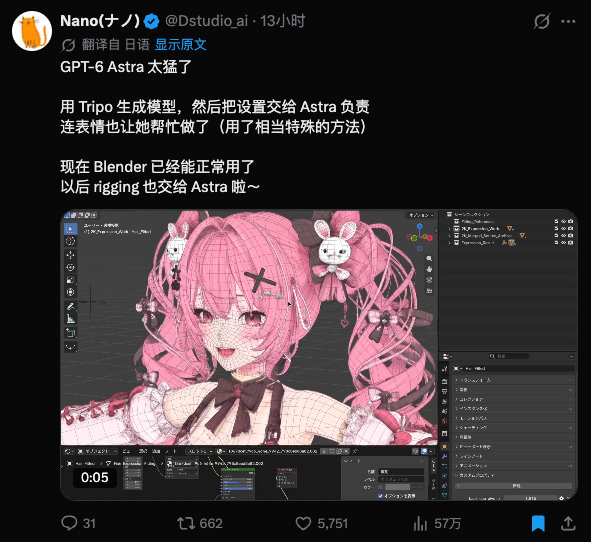
Someone asked Astra to generate a 3D model in Tripo and then imported it into Blender, which took over the assembly and adjustment of expressions; someone asked Astra to control Houdini to animate the model. That’s right, it’s Houdini, which has a very high professional threshold, and Astra can already be used directly.
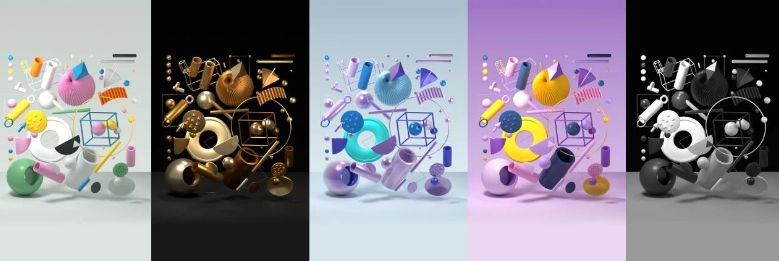
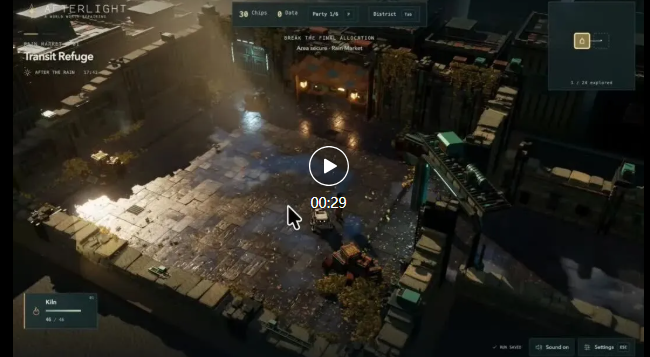
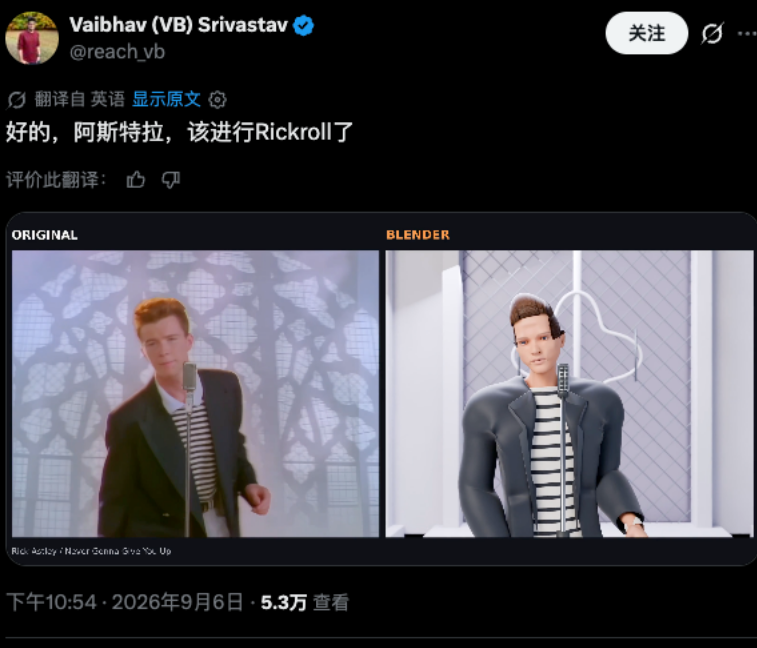
Some friends use Astra to control Blender, reproducing the works of other creators, and deriving five sets of different color combinations; others also use Astra to reproduce scenes in Blender. Taking it a step further, some creators used Astra to combine Blender and Unity to complete a small game demo.
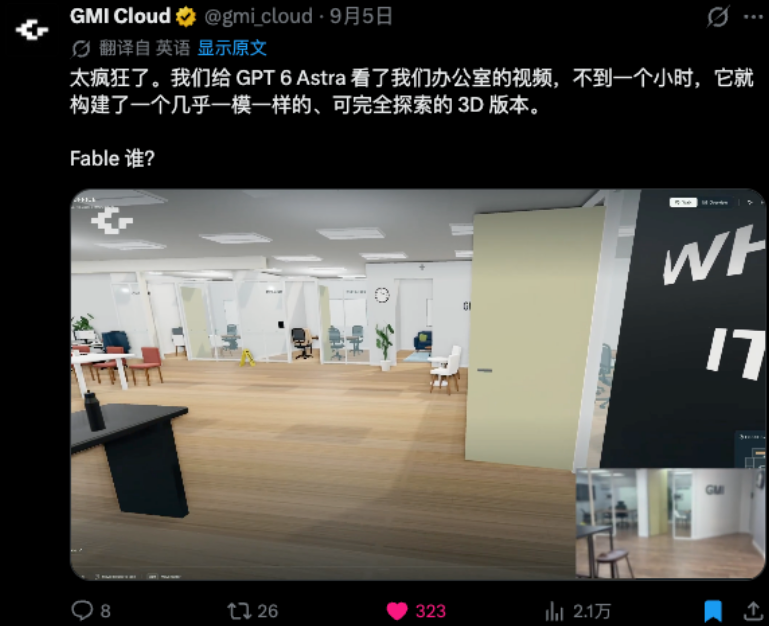
There is also a video to recreate the scene in Blender.
It may not be called a “great work” in the eyes of mature game producers, but its significance lies precisely in that.
What kind of hardships did independent game developers go through in the past? One of my favorite games, “The Balance of Gods,” was made by the producer KEIZO for 15 years, almost using up the most precious time in his life. Its art and levels are not exquisite: there are many free materials, free pictures, and resources donated by other authors in the early version; the music also uses a lot of free materials from Japan. Later, Vanilla Club Art Shigatake – who had participated in “Thirteen Sentinel Defense Circle” – happened to be a power generator for love and helped redraw a large amount of art, and the work gradually became what it is today.
But its script and gameplay are strong enough, so it is still regarded as a masterpiece by countless players.
Every time I play “Scale of Gods”, I feel regretful: If KEIZO started making it in the AI era, and if he had tools like GPT-6 Astra in his hands, what would be the upper limit of this work?
Unfortunately, there is no if. Those 15 years have passed.
And this is the significance of Astra being able to independently control Blender and Unity to make game demos today.
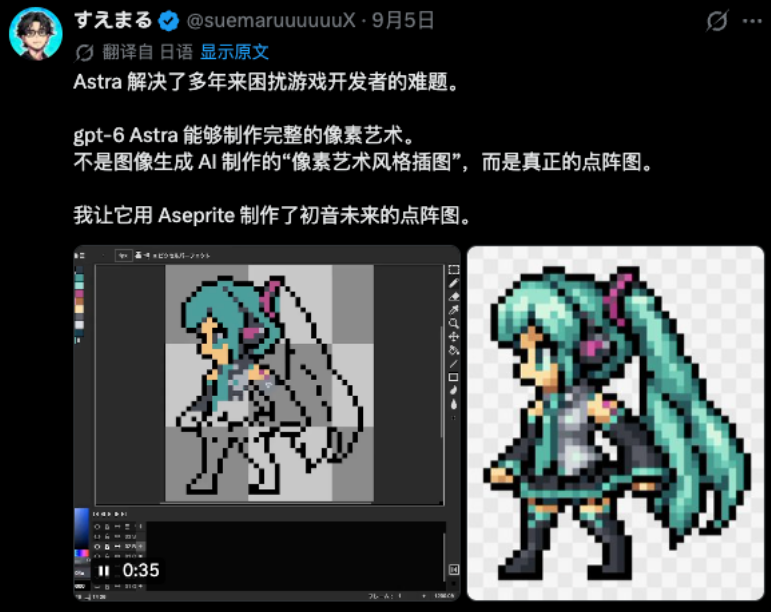
It’s more than that. @Anshu also made a more exquisite demo, and the modeling process was all completed by Astra controlling Blender. In addition to game modeling, it can also control Aseprite – a software that specializes in drawing pixel paintings and making 2D pixel animations – to generate pixel-style images; some people also use it to color line drawings.
I haven’t experienced the Internet atmosphere these past two days for a long time.
It’s a bit like GPT Image 2 when it first came out, and it’s a bit like Nano Banana when it first came out: everyone suddenly entered the “it can still be played like this” moment together.
The most shocking one is the case where Astra recreated the San Francisco Palace of Fine Arts in Blender.
It searched hundreds of reference pictures and repeatedly adjusted the model; it rendered the intermediate results, then compared the rendered pictures with the reference pictures one by one and continued to modify them. It even turned to an old scanned document from the Library of Congress to find the true dimensions of the building’s columns. The author only made a few corrections during the process: the color of the sky was not accurate enough, and some models had mold wear… Most of the work was done by Astra himself at night. By the next morning, the rendered video was already lying on the computer desktop. virtual card
Some people say that this may be what the Renaissance will look like.
There are too many similar cases, too many to imagine. Human creativity and thoughts can be so abstract and rich. In the future, “letting AI operate professional software” itself may even become a new benchmark test.
Background: When software capabilities become the toolbox of AI
In the past few decades, humans have created an extremely large digital civilization.
Blender has complete 3D capabilities; AE has accumulated decades of dynamic graphics and synthesis capabilities; DaVinci has mature video editing capabilities. There are also countless softwares that have accumulated working methods in various industries for decades or even hundreds of years.
These abilities have always been there. You can model, apply materials, render, tie bones, brush weights, spend a month, and get a short animation.
But all this has a premise:You have to know how to use it.
This sounds like nonsense, but there is an unimaginable threshold behind it. For many professions in the past, their barriers were built here: I am more valuable than you because I have used this software for five years, I am familiar with complex functions, and I am good at shortcut keys.
To this day, we will still see similar statements in resumes: proficient in PPT, Excel, Word, and editing; able to stably use Beanbao and DeepSeek to produce short video scripts; have tried C4D modeling, and used AE to produce some special effects…
This is reality.
In the past few decades, there has been a thick layer between professional abilities and ordinary people. I thought about it for a long time and thought it could be summed up in four words:Execution ability.
The impact of GPT-6 Astra is that it makes “execution ability” lose its original scarcity in the visible future.
You know how to use Houdini, so what? No matter how familiar you are with C4D, what does it matter? When AI clicks faster and more accurately, and can try to reproduce a video in 3D software, pure operational proficiency will become increasingly difficult to form a barrier.
Of course, it is still not perfect and may even be “abstract” at times. But think about the large-model programming capabilities in 2024: As long as AI is given another half a year or a year, when its reproduction ability is close to that of top humans and it can collaborate with you in real-time to complete complex works, we may not be able to laugh anymore. virtual card
All high costs, all delays, and all slowness will be gradually eliminated by the progress of AI.
All this comes from Computer Use and the generalization of GUI operation capabilities.
Some people think that GUI is not important in the Agent era, but I don’t agree. GUI may gradually become the most common API in the Agent era. Its true meaning is to add an AI compatibility layer to the software capabilities accumulated by humans over the past few decades.
Just as the most suitable form of embodied intelligence is often humanoid, GPT-6 Astra also seems to suddenly turn the entire human software world into its own toolbox: an industrial software with 5,000 buttons, a company ERP written in 2008, and an architectural design software that has never provided an interface for AI – all do not need to be modified first, AI can directly learn how to use it.
In the past, we would ask: What should we do if AI can’t do 3D? Then train a 3D model; what if AI doesn’t know how to design a circuit board? Train another PCB model.
Now there seems to be another, more direct path:Since humans have already used software to complete these tasks, why not let AI directly learn to use these software?
The capabilities accumulated by the software industry over decades are the real treasures.
Pain point: When execution is no longer scarce, how can individuals and teams build advantages?
After Astra was released, I was actually a little anxious.
I am not only a blogger, but also the person in charge of a company of more than thirty people. Under the shock, I once wrote this sentence:“Pure tasks and execution will become increasingly meaningless in the future.”
Looking back now, this expression was too extreme. A more accurate statement would be:
By performing this action, scarcity is being lost.
Execution of course remains important. Models in Blender still need to be built, and animations in AE still need to be keyframed; it’s just that the person completing these actions does not necessarily have to be a real person.
So, we entered a very strange state:
The distance between the intention in your mind and the final result in the computer is rapidly shortening.
In the past, this distance was extremely valuable and formed a barrier and moat for many professions. Today, operational knowledge itself is losing its scarcity, and with it, performing the action itself is no longer so scarce.
In my opinion, the value of many professions in the future will be forcibly split into two levels:Judgment with Execution ability.
Take the example of a 3D designer. In the past, “understanding 3D” and “being proficient in Blender” were almost bound together; in the future, they will gradually be decoupled.
Whether you can operate Blender may no longer be that important; more important is whether you understand whether the model proportions are correct, whether the space is comfortable, whether the materials match the overall tone, and whether the scene composition is aesthetic.
These judgments will become increasingly important.
Knowing Blender does not mean knowing 3D. Knowing AE does not mean knowing animation. Knowing CAD does not mean understanding architecture. Knowing Excel does not mean knowing finance.
In the past, these capabilities were often bundled together simply because the execution threshold was too high.
Current situation: Judgment is becoming a more scarce ability
But then, the most alarming issue emerged.
When execution ability is no longer scarce, judgment becomes even more important. But where does judgment come from?
Unfortunately, for most people, it can only be honed bit by bit from the execution tasks that are being swallowed up by AI.
How come a person who has actually been using Blender for ten years can tell there might be something wrong just by looking at a model made by Astra? Because he’s done it too many times. He has seen countless failures and corrected countless details, and those experiences have finally settled into intuition that does not require explanation.
The so-called intuition may be something compressed in the brain after human beings have experienced tens of thousands of executions, tens of thousands of failures, and tens of thousands of modifications.
The same goes for me. The understanding of AI and content does not appear out of thin air, but is accumulated bit by bit after writing 685 original articles in the past three and a half years. virtual card
Then, an extremely paradoxical reality emerged:
The economic value of execution is rapidly depreciating; Many of the most valuable human abilities come from execution training.
GPT-6 can save you five years of running Blender, which is great. But in those five years, apart from memorizing shortcut keys and becoming familiar with buttons, did you also develop something else?
The answer is: Yes.
You have seen countless models, made countless bad models, and reworked countless times due to your own mistakes. Then you slowly understand: what is good and what is bad; what looks cool but cannot really be implemented.
AI can compress five years into five minutes.
But the real question is:
If results can be compressed, can human growth also be compressed?
I don’t know.
This is exactly what I think is the most contradictory and depressing thing about this era.
The best companies and education systems in the future may have to answer a question again:
What frictions should be eliminated by AI? What frictions must be left to others?
One of the things AI is best at is helping us bypass pain.
But the cruel thing is that many human abilities grow precisely in pain.
There is a great word in the human world called Heritage.
I am afraid that one day, we “old men” will reach the age of retirement and are ready to hand over the mantle in our hands; when we look back, we will find that there is no one behind us.
This may also be a great sadness. virtual card
Solution: Use AI for verification and iteration rather than replacing business judgment
Leave repeated execution to tools, and leave goals, boundaries, customer value and final choices to people. Every time after using AI, use real results to review and adjust the next round of decisions, so that efficiency can truly be turned into long-term capabilities.
Virtual Card
Original article by Virtual Card Reviews & Cross-Border Payment Guides. If republishing, credit the source: https://visaspay.com/en/the-explosion-of-gpt-6-astra-made-me-see-a-gap-in-the-times/
Can I use a virtual credit card for ChatGPT subscription? First check the region, card issuance area, card and billing conditions, then check the web payme
Check regional eligibility, subscription or API billing, billing information, card verification and budget before paying for AI tools such as ChatGPT, Clau
After ChatGPT’s Work mode was launched, Tokens were consumed faster. This past weekend, many people were waiting for the ChatGPT/Codex quota to be reset. O
Let me explain first: “The first to use Codex to make TikTok” in the title is the author’s judgment of a working method and does not point to a verified pe