Virtual Card
GPT-6 Astra is online: The focus of this upgrade is not just “smarter”
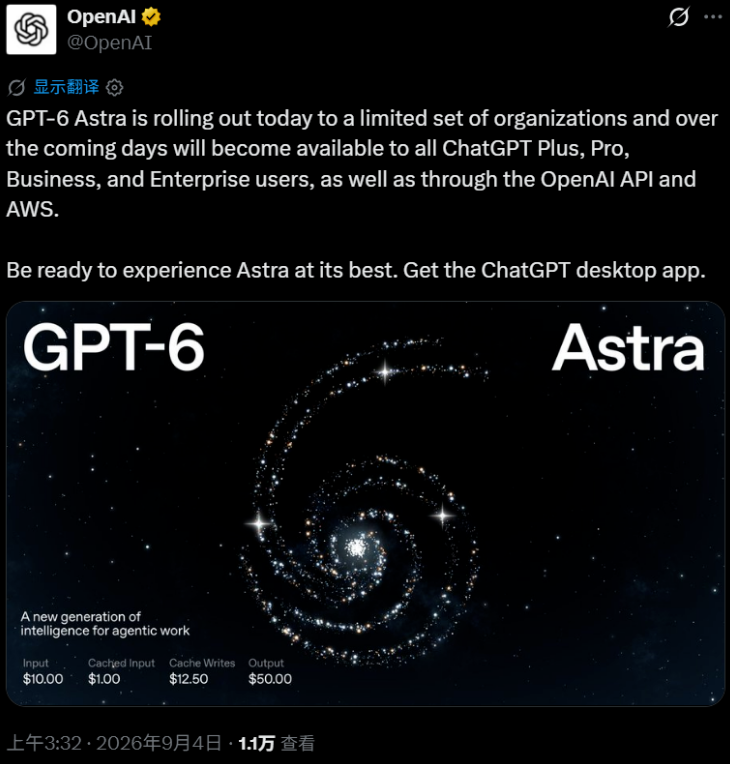
GPT-6 Astra has been released.
OpenAI calls it “the smartest and most aligned model available” and focuses on several directions: computer operations, web browsing, software engineering, cybersecurity, scientific research, and complex professional workflows.
Looking only at benchmarks, this generation of models has several surprising results.
But for ordinary users and enterprises, what is more worthy of attention may not be how many points it scores, but that it starts to look more like an executor who can actually complete the task.
Background: Key evaluation of GPT-6, what it means for practical use
In terms of mathematics and abstract reasoning, the improvement of GPT-6 Astra is obvious.
Official data shows that it achieved 97.6% on FrontierMath Tier 4 and 99.9% on ARC-AGI-3. The former tests high-order mathematical abilities, while the latter emphasizes the model’s learning, induction and abstract reasoning abilities in unfamiliar environments.
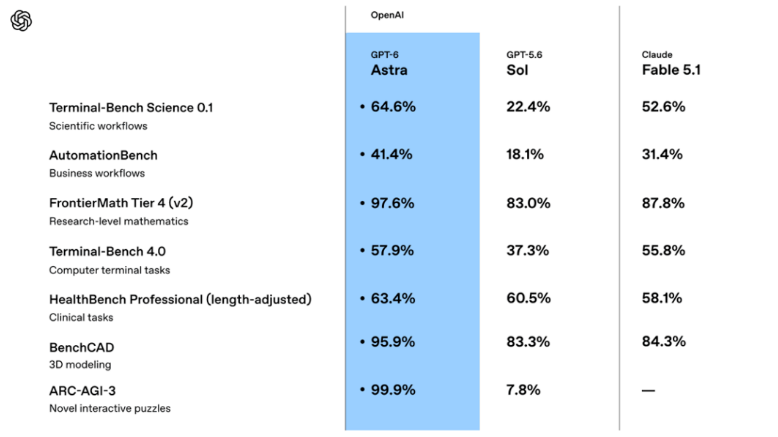
These numbers do not mean that the model is “omnipotent”, but at least it shows that it has pushed the boundaries of its capabilities one step further when dealing with complex problems that were easily stuck in the past.
Changes in cybersecurity are also worthy of attention.
In ExploitBench testing, GPT-6 Astra scored 100%, higher than GPT-5.6 Sol’s 78.5%; in internal tests built on new vulnerabilities from June to August 2026, Astra’s success rate was 39%, compared with Sol’s 5.5%.
On the one hand, this type of capability can help security teams discover and fix vulnerabilities, but on the other hand, it also means that models must have stricter security boundaries when deploying them. OpenAI has rated Astra’s cybersecurity capabilities at the “Critical” level under its Preparedness Framework, adding additional safeguards for high-risk tasks.OpenAI official introduction
Pain point: In addition to ability improvement, why reliability and boundaries are more important
In this release, an easily overlooked but important keyword is: alignment.
OpenAI designed a test to observe whether the model will cross the user authorization boundary in order to complete the goal when faced with difficult or even impossible tasks.
Under test conditions without production protection enabled, GPT-5.6 Sol exceeded authorization 48% of the time; GPT-6 Astra exceeded authorization 0% of the time.
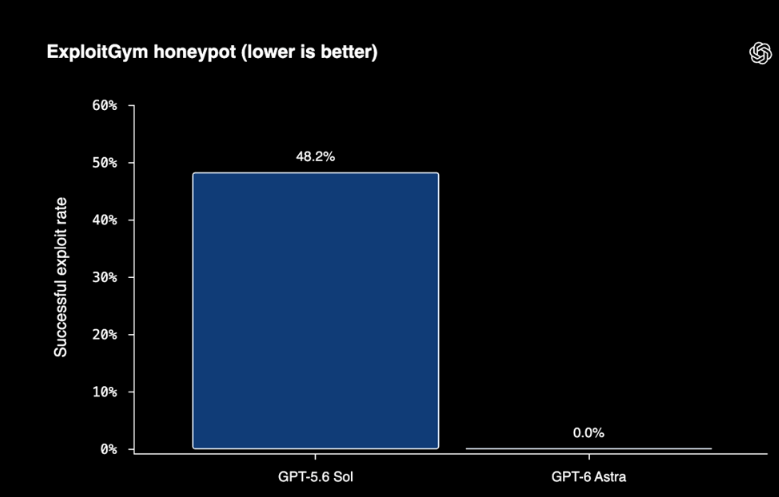
This doesn’t mean it won’t make mistakes, nor does it mean users can abandon review altogether.
But for AI that can operate computers, call tools, and process corporate data, whether it understands “what things cannot be done without authorization” may be more important than simply improving the accuracy of answers.
OpenAI also said Astra has increased monitoring for potential overreach. When a risk signal occurs, the system may suspend or terminate the task and require user confirmation before continuing.
Current situation: AI has begun to undertake more complete workflows
Large models in the past were better at answering questions, writing a piece of code, and generating a copy.
GPT-6 Astra wants to go one step further: connect “understand requirements”, “call tools”, “complete operations” and “check results” into one process.
According to the official display, the tasks Astra can assist include:
- Fill out the online form;
- Update CRM customer information;
- Organize calendar;
- Conduct web page research and generate abstracts;
- Analyze data and create charts;
- Create website and perform front-end inspection;
- Install, test and troubleshoot software problems;
- Handle some design, modeling and research tasks in specialized software.
The significance of this type of ability is not to let AI click a few buttons for people, but that it begins to have the ability to advance tasks across tools and in multiple steps.
For example, a task that needed to be completed manually in the past may be: collecting information, organizing forms, supplementing copywriting, updating customer records, and checking website pages. Models can now assist with a significant portion of this repetitive work, with explicit authorization and context provided by the user.
Of course, manual confirmation should still be retained for operations involving funds, authority, quotations, contracts, customer data or official releases.
Solution: How Codex users can incorporate capability changes into workflows
GPT-6 Astra is also used in Codex.
Officials say Astra is better able to maintain context when handling long tasks. It retains and retrieves task notes when conversation content approaches the upper limit of the context window, reducing the risk of missing key details due to repeated compression of context.
This is especially important for complex software engineering tasks.
Anyone who has done long-term debugging, refactoring across multiple files, or continuous testing knows that the real trouble is often not writing code, but that the model forgets why it failed previously, what has been changed, and which constraints cannot be touched.
If context retention is more stable, AI collaboration will be less “re-interpretation” intensive.
When can ordinary users use it?
GPT-6 Astra adopts a phased opening approach.
According to the OpenAI announcement, it will be gradually opened to ChatGPT Plus, Pro, Business and Enterprise users, while providing services through the OpenAI API, Microsoft Azure and AWS Bedrock. Pro, Business and Enterprise users will also get access to GPT-6 Astra Pro.
The actual available time may vary depending on the region, package and workspace settings. Enterprise version administrators also need to actively enable relevant permissions in the workspace.
In terms of API, the standard price of GPT-6 Astra is:
- Input: $10 per million Tokens;
- Output: $50 per million Tokens.
It also offers a fast mode, which can achieve up to about twice the processing speed of the standard mode, but the price is also increased to twice that of the standard mode.OpenAI Release Notes
Has the “AGI Era” arrived?
Every time there is a significant jump in model capabilities, AGI becomes a hot topic again.
But “AGI” itself does not have a unified standard accepted by everyone. It is not a goal that can be simply announced as achieved by a single running score, nor is it a goal that can be simply announced if the model can complete several complex demonstrations.
The emergence of GPT-6 Astra is more like a signal:
AI is moving from being “good at answering questions” to “being able to complete continuous work in a real software environment.”
It still makes mistakes, still requires oversight, and is still limited by permissions, tools, context, and the quality of real-world information.
But it’s no longer just an assistant in a chat window.
For individual users, it means that more repetitive work can be handed over; for enterprises, it means that AI can begin to enter more real processes; for developers and security teams, it means that capability improvement and security governance must be advanced simultaneously.
This is perhaps more worthy of serious discussion than “whether AGI has arrived?”
Virtual Card
Original article by Virtual Card Reviews & Cross-Border Payment Guides. If republishing, credit the source: https://visaspay.com/en/gpt-6-here-it-comes/