Virtual Card

Cross-border corporate procurement often encounters the same trouble: employees need to purchase cloud services, software subscriptions, advertising resources or overseas materials, but approval, payment, reimbursement and reconciliation are scattered in different systems. Waiting for physical cards, finding financial payment, employees advancing funds, and sorting out bills at the end of the month are not only slow, but also error-prone.
The value of the VCC virtual card is to make enterprise procurement easier: after the purchase application is approved, an independent virtual card can be issued according to the project, employee or supplier. It can be frozen or expired after use, so that the payment is no longer stuck in “waiting for the person, waiting for the card, waiting for reimbursement”.
Background: Why do cross-border purchases often get stuck between payment and reconciliation?
1. No need to wait for a physical card for temporary purchases
When encountering software renewal, advertising account recharge, cloud service activation or sample purchase, enterprises can directly create virtual cards after completing the approval. There is no need to wait for the physical card to be mailed, and there is no need to hand over the main card information to multiple people.
Whether it supports instant card issuance, the number of sub-cards and control capabilities need to be subject to the actual functions of the service provider.
2. Employees do not need to advance money before reimbursement
The common process of traditional procurement is that employees pay with personal cards first, and then submit invoices, screenshots and reimbursement forms. VCC can allocate controllable amounts to employees or projects, allowing companies to pay business expenses directly.
The benefits are:
- Reduce the pressure on employees to advance funds;
- Financial reduction reimbursement review;
- The company will not expose the main card information to multiple people;
- Every purchase is owned from the beginning.
3. One card corresponds to one project or supplier
Businesses can create different cards for different purposes:
| Usage scenarios | A more convenient way to use cards |
|---|---|
| AI, SaaS, cloud service subscription | One cycle card for one supplier |
| Overseas advertising | One card for one advertising account or project |
| Samples and temporary purchases | One single-use card for one order |
| Employee travel and temporary expenses | One employee or one travel ticket and one card |
| Supplier Bill Payment | One invoice corresponds to one card |
In this way, when you reconcile the accounts at the end of the month, you no longer need to guess “who spent the money and what they bought” from a large amount of turnover.
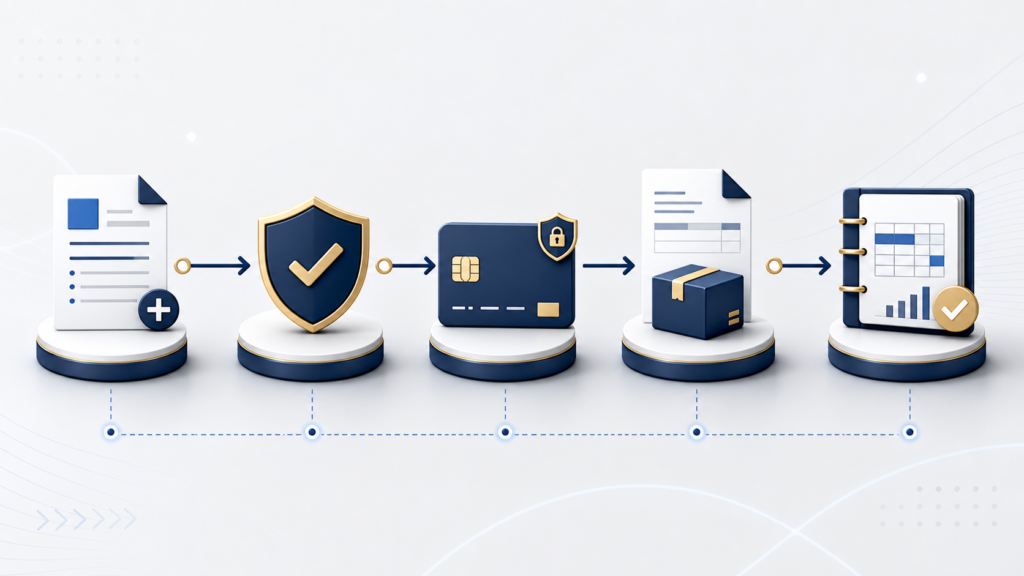
Pain point: What costs will the team pay when application, approval, payment and reconciliation are scattered?
Enterprises can simplify the procurement process into five steps:
- Employee submits purchase requisition: supplier, purpose, amount and order link.
- Online approval by the person in charge: Confirm budget and business necessity.
- Finance or system generated VCC: Set amount, validity period and usage limits.
- Employee completes payment: No need to touch the business owner’s account.
- Transactions are automatically attributed to projects: Finance can quickly reconcile based on orders, invoices and card names.
For cross-border enterprises, this method can reduce repeated communication. The purchasing department does not need to urge the finance department for payment, and the finance department does not need to inquire about the purpose of the purchase on a case-by-case basis.
Current situation: How VCC makes corporate procurement easier to manage
The convenience of corporate procurement is not only “fast payment”, but also “easy management after payment”.
Pay according to budget
Each card can have a fixed limit. For example, if the annual fee budget for a certain design software is US$1,200, set a corresponding limit only for that card to avoid spending beyond the budget.
Pay by time
One-time purchases can be set to be valid for a short period of time; subscription cards can be set to a fixed monthly limit. After the project is over, you can close the card directly without worrying about the old subscription continuing to be charged.
Pay according to usage
With the support of the service provider, enterprises can configure restrictions on merchants, regions, online transactions or merchant categories to reduce the risk of the card being used for other purposes.
Pay per person
When an employee leaves, the project ends, or the position is adjusted, you only need to close the corresponding virtual card without changing the entire business owner account or notifying all suppliers to update payment information.
Solution: Start with 4 types of standardized scenarios
For companies that are just starting to use VCC, it is recommended to start with low-risk, standardized procurement:
- SaaS subscriptions for AI tools, design software, collaboration tools, etc.;
- Technology procurement such as cloud servers, domain names, development tools, etc.;
- Advertising testing with clear budget caps;
- Purchase of small samples, office supplies and temporary materials.
In these scenarios, the amount is clear, the payment frequency is stable, and the order can leave traces. It is easiest to establish a standard process of “application-approval-payment-reconciliation”.
When choosing a service: Don’t just look at the card opening speed
A truly convenient enterprise VCC service should have at least:
- KYB corporate certification and corporate authorization management;
- Sub-accounts, role permissions and approval records;
- Card freeze, limit, validity period and transaction notification;
- Clear recharge, exchange, consumption, refund and service fees;
- The flow chart can be exported, preferably connected to the financial or ERP system;
- Formal customer service, work order and refund processing paths;
- Clearly explain service areas, currencies, merchant restrictions and risk control rules.
Is
Commercial virtual card solutions such as Visa and Mastercard generally emphasize control capabilities such as amount, time, merchant category, transaction data, and approval process. However, the actual functions that enterprises can use still need to be based on the products of the card issuer and service provider. (Visa Corporate Virtual Card, Mastercard Corporate Virtual Card)
Conclusion: Turn procurement efficiency into sustainable management capabilities
For cross-border enterprises, the most direct benefits of VCC virtual cards are: making purchases faster, making employees more worry-free, making financial reconciliation better, and making budgets easier to control.
It does not replace supplier review, contract, tax and corporate compliance processes; but in daily SaaS, advertising, cloud services and small cross-border procurement, it can significantly reduce the time cost of waiting, advance payment, repeated communication and manual sorting.
Virtual Card
Original article by Virtual Card Reviews & Cross-Border Payment Guides. If republishing, credit the source: https://visaspay.com/en/vcc-virtual-card-for-cross-border-corporate-procurement-make-application-pa/