Virtual Card
Internally we call this style of play “Raising Xiaoqiang”.
Why is it called this name?
Because its core is not to increase the budget suddenly from the beginning and bet on the popularity of a certain advertisement, but to continuously test, screen and cultivate a group of small advertisements in the account that are stable, resistant to pressure and can run in the long term.
A single advertisement may seem inconspicuous, but when the number of such advertisements gradually accumulates, it will have strong vitality like “Xiaoqiang”: stable consumption, stable order placement, resistance to fluctuations, and easier to continue to expand.
The essence of this style of play is:Use a small budget to test the model, use automated rules to screen high-quality ads, and then let the system gradually increase the volume.
What problems does “Yang Xiaoqiang” mainly solve?
During Facebook launch, many accounts will encounter the following situations:
- Unable to afford advertising: I want to spend money, but the system does not allow the amount; once the amount is forcibly increased, the cost rises rapidly.
- The performance is good with a small budget, but collapses as soon as the budget is increased: CPA becomes higher, ROAS declines, and the originally profitable advertising becomes unstable.
- When the number of advertisements increases, manual budget adjustment is very inefficient: it is time-consuming and it is easy to miss the appropriate volume node.
- The learning period fluctuates greatly: Budget, structure or materials are frequently adjusted, making it difficult for advertising to accumulate data stably.
- I don’t want to repeatedly split the audience and keep an eye on the budget every day: I want to run a broad audience advertisement for a long time in a more worry-free way.
To put it simply, “Yang Xiaoqiang” does not pursue a sudden explosion of orders for a certain advertisement, but uses “small budget, multiple tests, and automated screening” to gradually cultivate a batch of advertisements that can maintain stable consumption and stable orders for a long time.
It is particularly suitable for solving a classic puzzle:
It works well with a small budget, but collapses when the budget is enlarged.
What account is suitable for this style of play?
Let’s start with the conclusion: you can try it with most accounts.
Whether it is a new account, an old account, or an account that has accumulated certain data, as long as you encounter the following problems in the short term, you can take “Raising Xiaoqiang” as a test direction:
- Advertising consumption cannot be afforded;
- Once the budget is added, the cost will increase significantly;
- There are too many ads and manual budget adjustment cannot keep up;
- Hope to go through the learning stage more smoothly;
- Hope to run broad audience ads for a long time and reduce the workload of frequently splitting audiences.
The focus of this strategy has always been not to “bet on a hit advertisement”, but to establish a sustainable advertising screening and volume increase mechanism.
The real value in the account is not a certain advertisement that has been popular before, but a batch of “little strong advertisements” that can achieve long-term sales and continue to make profits.
1. How should the budget be set?
The most common question asked by many novices is: How much should the budget be?
If you don’t have clear test standards yet, you can start with USD 20/day Start.
The trial and error cost of this budget is relatively controllable, and it is enough for advertising to accumulate preliminary data to determine whether the materials, landing pages, and conversion links have potential.
Of course, $20 is not the fixed answer.
If your average order value and margins are higher, or your account data is relatively stable, you can adjust the testing budget accordingly. If margins are thin or acquisition costs must remain tightly controlled, keep early testing costs within a suitable limit.
There is only one core principle:
Don’t use a heavy budget in the early stage. Let the advertising run out of direction with a small budget.
2. How to set up the advertising structure?
It is recommended to use this style of play first 1-1-1 structure:
- 1 Campaign
- 1 Ad Set
- 1 Ad
The biggest advantage of such a structure is that the data is clear, easy to judge, and easy to adjust individually.
Many accounts have too complicated structures from the beginning: multiple campaigns, multiple ad groups, and a large number of materials are piled together at the same time. In the end, even if the data fluctuates, it’s difficult to tell whether the problem lies with budget, audience, creative, or the ad structure itself.
In the “Raising Xiaoqiang” style of play, each advertisement should be a relatively independent test unit.
Keep ads that perform well and continue to cultivate them; ads that do not perform up to standard will be suspended or replaced in a timely manner. In this way, truly stable models can be continuously screened out.
3. How should the audience be set?
If you have tested an audience with stable performance, you can directly use the existing audience.
But if you don’t have a clear high-quality audience yet, I recommend using it directly Broad audience (Broad, also known as “airdrop”).
The reason is simple: this style of play uses a small budget for testing in the early stage, so it will not consume a large budget at the beginning. You can first let the system look for users who are likely to convert within a wider range of people, and then filter high-quality ads based on actual data.
If the advertisement can run stably in the future, it can continue to retain a wide audience without having to split a large number of interest packages frequently.
This is also one of the advantages of the “Raise Xiaoqiang” style of play:
Reduce human intervention and focus more on materials, profits and advertising rules.
4. Core link: gradually increase the budget using automated rules
The most critical part of “Raising Xiaoqiang” is to leave budget adjustments to automated rules as much as possible.
Why?
Because increasing advertising volume is not simply a matter of directly increasing the budget from 20 US dollars to 100 US dollars.
Many advertisements are not incapable of increasing volume, but because budget adjustments are too radical, disrupting the original delivery rhythm, which ultimately leads to rising costs and declining ROAS.
A more reliable way is:
Based on advertising performance, increase the budget in small steps, in stages, and gradually based on results.
That is to say:
- If the ad performs well, give it more budget space;
- If the advertising performance is average, just maintain observation;
- If advertising performance declines, stop increasing the budget.
The purpose of this is not to make advertising explode overnight, but to allow high-quality advertising to gradually accumulate consumption and conversion, and grow in a relatively stable rhythm.
5. Automation rule reference settings
The following is just an example of an idea. The actual threshold should be adjusted based on your customer price, profit margin, CPA and break-even ROAS.
Assume your initial advertising budget is USD 20/day.
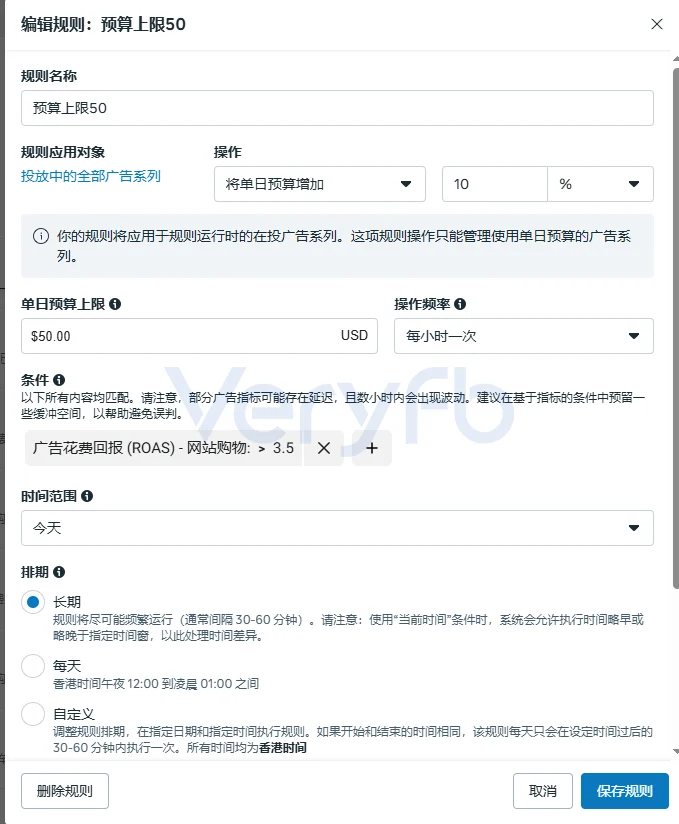
When the ad has generated conversions and the ROAS is higher than 3.5, you can set the first layer of automation rules:
- Condition: Results have been produced and ROAS is greater than 3.5;
- Budget limit: $50;
- Inspection frequency: every hour;
- Adjustment method: Increase the budget by 10% each time.
The “budget limit of $50” here does not mean that the ad will definitely spend $50 on that day.
Its function is to give well-performing ads more space to increase their volume and avoid premature advertising deceleration caused by low budgets.
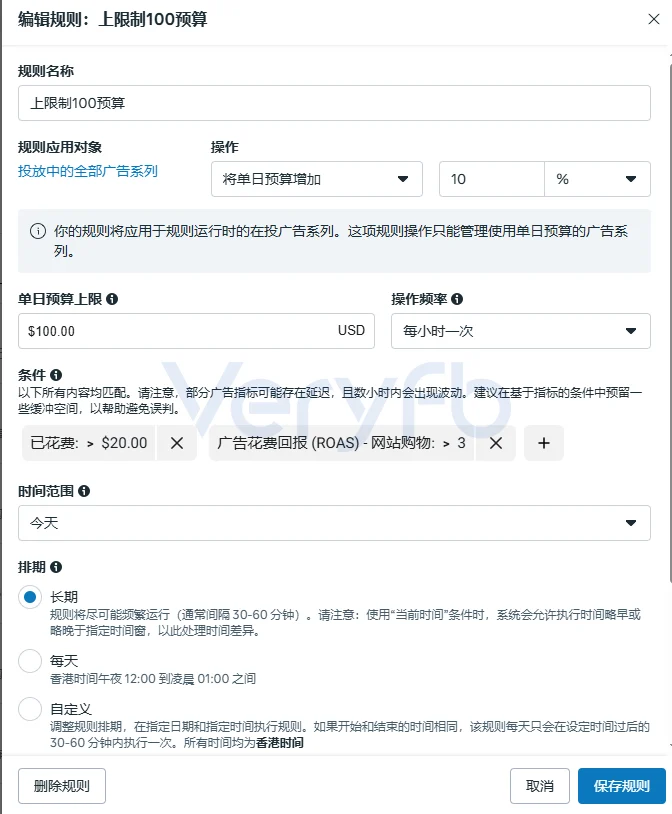
When the advertisement continues to be stable, a second layer of rules can be added:
- Conditions: Spend up to 20 US dollars, and ROAS is greater than 3.0;
- Budget limit: $100;
- Inspection frequency: every hour;
- Adjustment method: Increase the budget by 10% each time.
If the ROAS of an ad drops during the budget increase process and no longer meets the rule conditions, the system will stop adding the budget.
This is the value of automated rules:
If the performance is good, the system will automatically increase the amount slowly; if the performance deteriorates, the system will automatically stop increasing the amount. Virtual Card
6. Budget rules can continue to be superimposed upwards
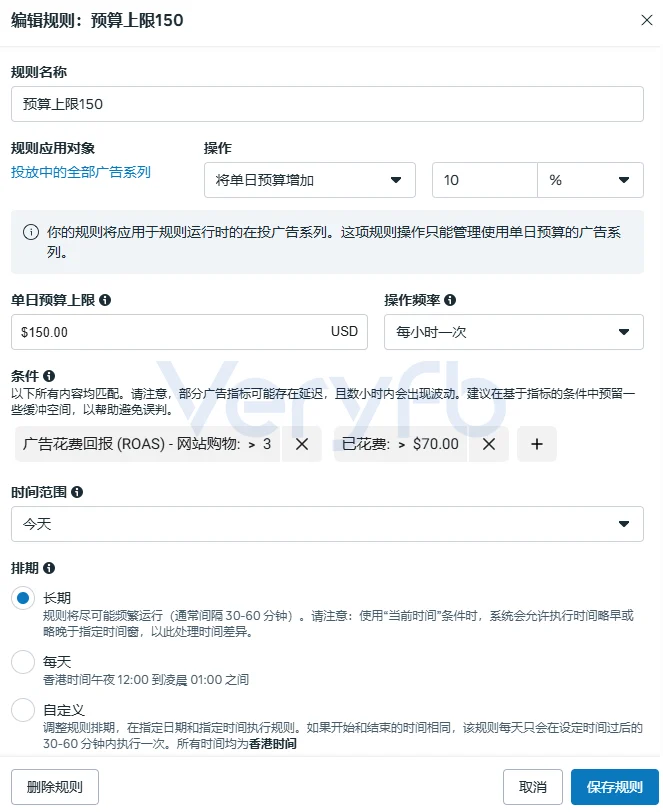
US$50 and US$100 are just a reference, not a fixed standard.
If the advertising continues to be stable, you can continue to set a higher-level budget cap according to the same logic, for example:
- First level: budget limit is $50;
- Second level: budget limit is $100;
- The third level: budget limit is 200 US dollars;
- Level 4: Budget limit is $300.
Each layer follows the same principle:
Reach a certain consumption, ROAS standard, and increase the budget slightly each time.
In this way, advertising is not roughly amplified, but is “raised” step by step at a pace that the system can bear.
7. ROAS standards must be determined according to the profit model
The ROAS 3.5 and ROAS 3.0 mentioned in the article are just examples.
The actual standard you should use depends on your profit model.
If your profit margin is high, customer price is high, and repurchase ability is strong, you can appropriately lower your ROAS requirements; if your profit margin is low and fulfillment costs are high, you should set a more stringent ROAS threshold.
The core is not “whether the advertisement has been ordered”, but:
Whether this advertisement can still make money after increasing its volume.
Don’t increase volume for the sake of increasing volume.
If the advertising scale is larger and the losses are greater, it will not be a “little strong” but a “gold-eating beast”.
8. When should you stop and when should you retest?
When an advertisement has been added to a higher budget, if the following situations occur, it must be dealt with promptly:
- Continued consumption but no conversion;
- CPA is significantly higher than the acceptable range;
- ROAS continues to decline with no sign of recovery;
- Material fatigue or significant deterioration of data.
At this time, don’t continue to carry it just because it has performed well before.
You can first stop increasing the budget, reduce the budget, or pause advertising; if the model itself is still valuable, you can also copy new ads and retest, allowing the system to re-enter the learning and distribution stage.
“Raising Xiaoqiang” does not mean sticking to a certain advertisement, but continuously screening, supplementing, and cultivating new stable advertisements.
In the end, what really stabilizes the account is not an occasional hit-of-the-moment advertisement, but a batch of “little strong advertisements” that can consume for a long time, issue orders stably, and make continuous profits. virtual card
Virtual Card
Original article by Virtual Card Reviews & Cross-Border Payment Guides. If republishing, credit the source: https://visaspay.com/en/facebook-launch-actual-combat-raise-xiaoqiang-strategy/