Virtual Card
When many people first started advertising on Facebook, they felt that the account structure was not important: just running well, having orders, and having a decent ROI.
But as the budget for the day increases from a few hundred dollars to tens of thousands of dollars, you will find that what really brings down the account is often not that a certain piece of material suddenly fails, but that the account itself is so messed up that it cannot be managed.
There are too many ad campaigns, and the ad group names are incomprehensible; testing, volume expansion, and remarketing are all crowded together; when you want to turn off loss-making ads, you can’t find which layer the problem is at.
When the budget is small, the structure is a little messy and the impact is not big. With a big budget, clutter is the cost.
This article does not talk about metaphysics, but directly explains the underlying structure and common construction methods of Facebook (Meta) advertising accounts. After reading this, at least three questions can be solved:
- What are the responsibilities of each campaign, ad group, and ad?
- How should we measure materials, people, and volume?
- When the account consumes tens of thousands of dollars every day, how can the team still understand and manage it?
1. First understand the “three floors” of Facebook advertising
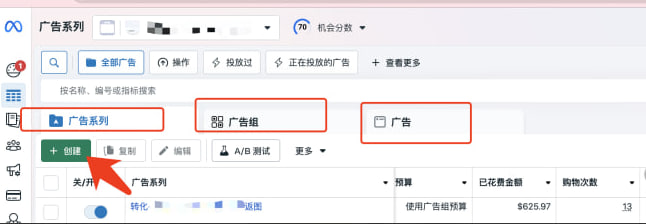
Whether you are investing in independent website conversion, form customer acquisition, brand exposure, or driving traffic to Amazon or eBay, the basic structure of the Meta advertising backend has only three layers:
- Campaign: Determine advertising goals, such as sales, leads, interactions, traffic, etc.
- Ad Set: Determine budget, crowd, region, placement, optimization events, delivery time, etc.
- Advertisement (Ad): Put materials, copywriting, title, landing page and CTA.
You can understand it as building a building:
The advertising campaign determines what the building will be used for; the advertising team determines who to sell it to, where to sell it, and how much it costs; and the advertising determines what customers ultimately see.
All subsequent testing, copying, scaling and optimization cannot escape these three layers. First, clearly distinguish what each layer should do, so that the account will not become more chaotic.
2. How to build an advertising campaign? Look at your purpose first
Many people come up and ask: “Should I use 1-1-1 or 1-4-4?”
In fact, no one structure fits all accounts. The structure is not to look good, but to answer the question: What do you want to test this time?
Usually, the advertising campaigns in the account are mainly responsible for three things:
- Test material
- Test Audience
- Undertake heavy volume
1. 1-1-1: The simplest quick verification model
The so-called 1-1-1 means:
- 1 campaign
- 1 ad group
- 1 ad
This structure is ideal for testing an explicit hypothesis.
For example, you want to test a new product, a new market, or a new piece of material that you are confident about. Its advantage is that it is simple, and the data will not be interfered by too many variables; its disadvantage is also obvious, the testing efficiency is not high, and it is not suitable for large-scale material running.
2. 1-4-1: More suitable for test audience
The structure is:
- 1 campaign
- 4 ad groups
- Place the same ad in each ad group
The purpose of this combination is to keep the advertisement as consistent as possible and only change the audience.
For example, four ad groups are tested separately:
- Interested groups
- Similar Audiences
- Broad audience
- A certain segmented group of people
If you want to know “is it a problem with the material or the crowd”, this structure will be easier to see.
When testing audiences, it is recommended to prioritize ad group budgets. In this way, each audience can get relatively independent spending, and it is not easy for the system to allocate all the budget to one of the ad groups, resulting in no data for other groups.
3. 1-1-4: Concentrated testing materials
The structure is:
- 1 campaign
- 1 ad group
- 4 different ads
The ad group keeps the same set of audiences, regions, placements and optimization events, and only tests different creative materials at the advertising level.
For example, you can test the same product at the same time:
- Product pain point video
- User feedback materials
- Scenario usage materials
- Discount promotion pictures or videos
This structure is suitable for quick judgment: which creative direction is more likely to bring clicks, additional purchases and purchases.
If the system already has enough data, you can also use a series budget to automatically tilt the budget towards materials with better performance. If you want each piece of material to get a more balanced test opportunity, you need to control the testing pace and not stuff too many materials into it at once. virtual card
4. 1-4-4: Test multiple audiences and multiple materials at the same time
The structure is:
- 1 campaign
- 4 ad groups
- 4 ads per ad group
The testing efficiency of this structure is very high, but there are also many variables.
It is suitable for accounts with a certain budget and stable material production capacity. For example, you have determined that your product can be sold, and now you want to test different groups of people and different material directions at the same time.
But be warned: if you don’t have enough budget, don’t just jump on 1-4-4. The budget is too spread out, and no valid data can be generated for each advertisement. In the end, you will only get a bunch of “inconclusive” tests.
5. Large-scale testing audience: 1-30-1, 1-50-1 or even more
When you need to quickly screen a large number of interests, crowd packages or market segments, you can use:
- 1-30-1
- 1-50-1
- 1-100-1
That is, one advertising campaign is divided into many ad groups. Each ad group uses the same ad and only adjusts the audience.
This type of structure is usually paired with a lower ad group budget and is used to filter the direction, not to directly increase the volume. For example, each ad group is given 5 to 10 US dollars a day to get preliminary signals first, and then the high-performing audiences are taken out for independent verification and the budget is increased.
Don’t confuse “test pool” and “volume pool” together. The former allows trial and error, while the latter requires stable results. The management logic of the two is different.
3. When experts look at their accounts, they don’t just look at one advertisement, but look at the entire plate.
When the daily account consumption is only a few hundred dollars, a slightly more extensive structure is not a big problem.
But when the cost reached $50,000 that day, the situation was completely different.
Assume that the daily budget of an advertising campaign is US$500, then the daily consumption of US$50,000 may correspond to 100 advertising campaigns, 500 ad groups, and thousands of ads.
The most important thing at this time is not “how many ads are on”, but whether you can find it in a few minutes:
- Which ads are making steady profits?
- Which ads are losing money?
- Which are just short-term fluctuations and should not be moved for the time being?
- Which materials are worth copying and amplifying?
- Which groups of people are tired and need to reduce the budget or stop it?
Therefore, large accounts should establish clear stratification instead of cramming everything into one series.
A more practical idea is to split the account into several clear modules:
- Test Series: Test new materials, new audiences, new products, and new markets.
- Large volume series: Undertake proven materials, people and products.
- Remarketing Series: Covers people who browse, add purchases, initiate checkout, repeat purchases by old customers, etc.
- Activity Series: Big sales, festivals, limited-time discounts, inventory clearance, etc.
- Brand or content series: Brand exposure, interaction, video viewing, social media operations, etc.
The advantage of this is that when you see the name of an advertising campaign, you will know the purpose of its existence and the criteria to use to judge it.
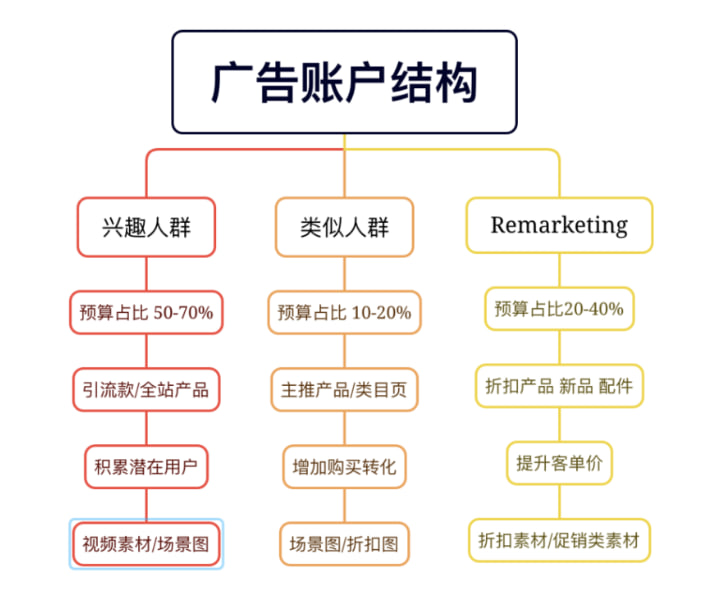
Draw a more ideal model diagram.
4. Don’t just “divide the budget equally” in the account
A healthy account usually does not rely on just one kind of group of people.
Common crowd structures can be divided into three categories:
- Cold flow: Interest, similar audience, broad audience, used to continuously attract new users.
- Remarketing group: Browsing, additional purchases, checkout without purchase, interactive users, etc., used to accept existing intentions.
- Regular customers: Repurchase, cross-selling, membership activities, new product notifications, etc.
The ROI of remarketing is often very good, but it cannot replace new acquisitions.
The most typical account I have seen: almost only running remarketing for two consecutive months, the background ROI is amazing, and the sales volume looks good. But the account did not continue to attract new users, and in the end it just kept chasing the original group of people.
The short-term numbers look good, but long-term accounts will definitely become more and more difficult to run.
Under normal circumstances, it is recommended that the remarketing budget be controlled within 25% of the total expenditure; it can be increased during major promotions, but it is best not to exceed 40% for a long time. If it exceeds 50% for a long time, you should go back and check whether the cold traffic is not running or the remarketing window is set too wide. virtual card
5. Materials and products must also be included in the account structure
Ad structure is not just the arrangement of Campaign, Ad Set, and Ad.
A truly mature account will incorporate materials and products into the structure.
Materials must at least be clearly classified, such as:
- Product design drawing
- Use scene graph
- User return pictures
- KOL or expert material
- Evaluation video
- Pain point material
- Contrast material
- Discount Promotional Materials
- Festival or promotion materials
Products must also distinguish their roles:
- Drainage money: Responsible for acquiring customers with low threshold.
- Best-selling model/hot product: Responsible for scale and cash flow.
- Profit money: Responsible for increasing overall profits.
- Accessories or additional purchases: Increase the unit price.
- Clearance deposit: Solve inventory turnover.
If a pitcher only focuses on the advertising background and does not understand the position of the product in the entire business, he will definitely encounter bottlenecks later.
Different products have different suitable materials, targets, groups of people and budget strategies. Drainage funds should not be deducted based on the ROI standards of profit funds; inventory clearance ads should not be mixed with regular high-volume ads.
6. After the brand becomes bigger, it is recommended to do multiple account management
When the brand scale increases, the advertising goals often go beyond “independent station conversion”.
You may also want to do:
- B2B Lead Acquisition
- Brand exposure
- Social media interaction and content promotion
- Drain traffic from Amazon, eBay and other platforms
- Exhibition or offline event promotion
- New market testing
At this time, it is more recommended to split the advertising accounts according to business goals instead of stuffing them all into one account.
This is not only for good looks, but more importantly for convenience of statistics and review.
Independent site conversion depends on MER, CPA, and ROAS; B2B depends more on lead quality and transaction cycle; brand advertising depends on reach, frequency, and video views; platform traffic must be judged based on off-site data.
Use different accounts and reporting logic for different goals, so that the team can know who each budget is serving.
Finally: Why is ad structure the lifeblood of your account?
Because a good structure will not make you better at shooting, but it will help you avoid making a lot of mistakes that you shouldn’t make in the first place.
It can help you do at least three things:
- Testing is more scientific: Only by changing key variables each time can the data have reference value.
- More efficient management: No matter how many ads there are, you can quickly find the parts that should be optimized.
- Expansion is more controllable: After running a winner, know what to copy, where to add, and what to stop.
Account creation is only the first step.
The real core is continuous data review, material iteration, product update and budget judgment. But a poorly structured account can amplify all this work into disaster.
When you don’t understand the account yourself, no matter how smart the system is, it can’t save you. virtual card
Virtual Card
Original article by Virtual Card Reviews & Cross-Border Payment Guides. If republishing, credit the source: https://visaspay.com/en/from-daily-consumption-of-us-500-to-us-50-000-explain-the-structure-of-face/