Virtual Card
When I saw the name ChatGPT Work, my first reaction was: Does it have another “more thinking” mode?
When I looked down, I realized that it wasn’t.
It changes not in answering a few more paragraphs, but in starting to take over a complete job.
In the past, when I asked ChatGPT to help with competitive product analysis, it would usually give you a framework, list several competitors, and remind you which indicators to look at. It already looks complete.
You can turn off the chat box, and the real troublesome part has just begun: you have to find information by yourself, verify data by yourself, organize tables by yourself, and do PPT page by page.
ChatGPT is like a colleague who has a very fast mind. If you ask it “how to do it”, it will immediately give you a lot of suggestions; but you still have to carry out the specific work yourself.
What ChatGPT Work wants to make up for is this step.
You no longer have to break a job into a dozen small questions and ask them one after the other. You can directly explain what you want in the end, and then clearly explain the information, format and restrictions. It will read the file, organize the information, disassemble the steps within the scope of your authorization, and finally produce a document, form, presentation, report, or even a web page that can be checked, modified and continued to be used.
It was you who asked after ChatGPT in the past.
Now it’s time to move forward towards the result.
For most people, this change may be more important than how much the model’s running score has increased.

One is responsible for thinking with you, and the other is responsible for doing the next thing
So is ordinary ChatGPT useless?
Of course not.
Chat is still suitable for things that are lighter and faster: ask a question, explain a concept, discuss a few topics, revise a paragraph of copy, or make a first draft.
When you only have a vague idea in your mind and don’t know where to start, it’s appropriate to chat with ChatGPT. It’s like having a colleague sitting next to you and available for discussion at any time. If you say something, it will follow another sentence; if you feel something is wrong, it will immediately change its direction.
Fast and light.
What Work faces is not a question, but a task.
This is also where the two are most easily confused. The focus of Work is not just to “write more”, but to connect the originally disconnected links: understanding the goals, reading materials, organizing information, generating deliverables, and then continuing to make changes based on feedback.
For example, if you ask ordinary ChatGPT to help plan a new product launch, it can give you the theme, process and copywriting direction.
If you give the same thing to Work, it can organize product selling points based on user research and existing data, complete the release plan, and create budget tables and presentations; after you read it, let it adjust according to your opinions.
One is responsible for thinking with you, and the other is responsible for carrying out the work.
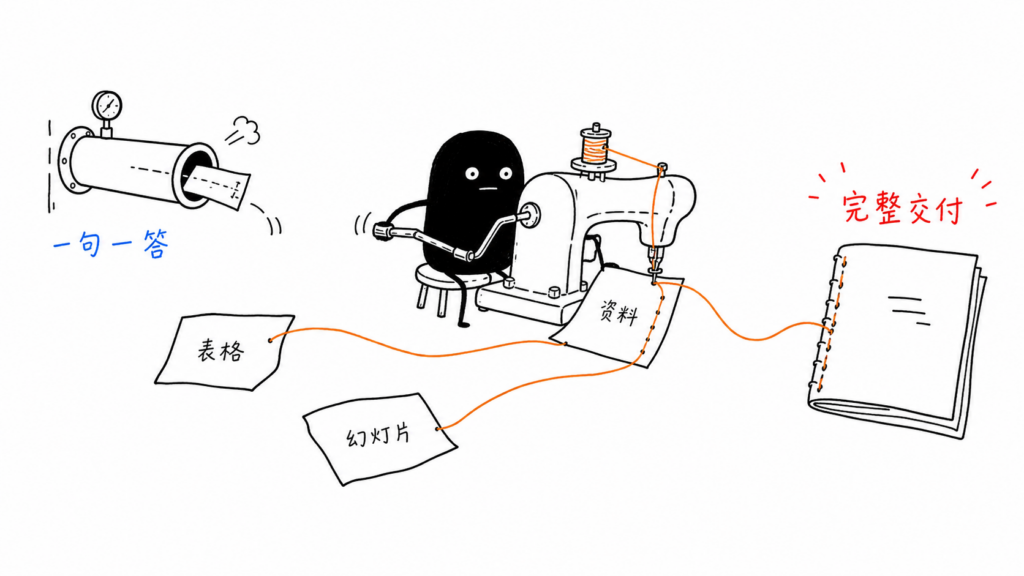
Work and Codex are two different work sites
Having said this, many people will ask: Since Work can even build a website, why do you need Codex?
Because they entered two different work sites.
Work is more like a project executor who promotes tasks across departments. What it cares about is whether the information has been found, whether the plan has been completed, and whether a usable thing can be handed over in the end.
Codex are technical colleagues who enter the project site. It faces the code warehouse, terminal and development environment. It can understand the project, modify multiple code files, run commands and tests, troubleshoot problems, and then submit the results to developers for review.
Let’s take new product launch as an example.
Chat can help you publish topics.
Work can organize market data and make plans, tables and PPTs.
Codex can truly build the product official website: modify the page code, access the form, run tests, and then check whether there are any problems before going online.
Therefore, the difference between Work and Codex is not who is stronger or weaker, but the default problems to be solved. virtual card
A default facing business goals and final deliverables.
One faces code repository and engineering tasks by default.
Of course there will be overlap in abilities, but the home field is different.
Know how to use AI and are changing from “being able to ask questions” to “being able to hand in tasks”
I think the most interesting thing this time is not that OpenAI has released another product.
But the way we get along with ChatGPT is changing.
In the past few years, everyone has been learning how to write prompt words. In order for ChatGPT to give better answers, we break down the work into more and more details: background, roles, steps, format, no one is left out.
Slowly, the person is like a project manager, and ChatGPT is like an intern who has to ask you every step of the way.
Work wants to push this relationship a little further.
You are no longer just responsible for asking questions, but you must learn to explain goals, provide materials, delineate permissions, and tell it what results will be considered completed.
If you are going to hand over a task to Work, you must make at least four things clear:
- Goal: Who is this thing for? What problem is it going to solve?
- Materials: Which documents, data and links must be used and which content can only be referenced.
- Boundary: Which content cannot be changed, and which operations require your confirmation first.
- Acceptance: What format and length should be finally delivered, and what standards should the conclusion meet. virtual card
For example, don’t just say: “Create a competitive product report for me.”
can be replaced with: “Based on the customer interviews and public information in the attachment, please complete a competitive product analysis for the sales manager. Focus on comparing prices, core selling points, and common customer concerns; use a PPT within 10 pages to present, and indicate the source of each key judgment. Do not send or share any files externally, and give them to me for review after completion.”
This is not about making the prompt longer, but about making the job more like a real job.
Of course, this does not mean that people can get off work just by saying a word.
Work can read files, connect to applications, and even facilitate actual operations. The more it is done, the more clearly people need to make permission boundaries and acceptance criteria clear. Especially before sending emails, sharing files, and modifying data, someone still needs to check and confirm.
It started to work.
But you can’t skip work completely just yet.
This time, is it chat or delivery?
OpenAI’s division of labor between the three is actually very straightforward:
If you only need an answer, use Chat.
If you want to get a finished product that can really continue to be used, give it to Work.
If you want to enter the code, terminal and development environment and complete a technical project, Codex is still the home field.
ChatGPT has not stopped chatting, and Codex has not been replaced by Work.
Just from now on, before opening ChatGPT, we may want to think about one thing clearly:
This time, do I just want to chat with it, or am I ready to let it really start working? virtual card
Virtual Card
Original article by Virtual Card Reviews & Cross-Border Payment Guides. If republishing, credit the source: https://visaspay.com/en/chatgpt-finally-started-working/