Virtual Card
As more and more companies expand into overseas markets, they are not only faced with the problem of “how to get the money back”, there is also an issue that is easily overlooked:
How to spend money and how to manage it?
Overseas advertising, SaaS software subscription, cloud service procurement, supplier payment, employee travel and other scenarios often involve multiple platforms, multiple teams and even multiple countries.
Many companies will encounter similar problems in the early stages of development:
- Multiple advertising accounts share one card, making it difficult to distinguish the use of funds;
- Employees or teams use personal cards to pay, making financial statistics difficult;
- Overseas subscription services are automatically deducted, which can easily lead to unexpected expenses;
- Bills for different projects are mixed together, making reconciliation at the end of the month very cumbersome.
The emergence of enterprise virtual cards is to solve these problems.
It helps companies to manage their originally dispersed and complex overseas expenditures in a unified manner, so that every payment has a record, a limit, and permissions, making it easier for companies to control costs and manage funds.

Background: What is an Enterprise Virtual Card?
Corporate virtual card is a digital bank card used for corporate payment management.
It doesn’t have a physical card, but it does have full payment information, including:
- Card number
- Validity period
- CVV security code
Businesses can use virtual cards to complete online payments, such as:
- Facebook/Google/TikTok Advertising
- Overseas SaaS software subscription
- Cloud server procurement
- Payment for overseas platform services
- Employee travel expenses, etc.
Different from traditional bank cards, the biggest advantage of corporate virtual cards is not “online payment”, but More flexible management capabilities.
Enterprises can create different cards for different scenarios based on actual business needs, such as:
- One advertising account corresponds to one card;
- One project corresponds to one card;
- One employee corresponds to one card;
- One supplier corresponds to one card.
At the same time, you can set:
- Single card limit;
- Usage permissions;
- Consumption scope;
- Capital budget.
In simple terms:
Traditional bank cards solve the problem of payment, while corporate virtual cards solve the problem of how companies manage payments.
Pain point: What is the difference between corporate virtual cards and traditional corporate cards?
Traditional corporate credit cards are usually suitable for fixed, concentrated consumption.
But for current overseas companies, business expenses are increasingly fragmented:
- Multiple advertising accounts are placed at the same time;
- Different markets operate independently;
- Collaborative procurement by multiple teams;
- Massive subscriptions to overseas tools.
If all expenditures are concentrated on one card, it is easy to:
- Don’t know where the money is spent;
- It is not clear which item generates the expense;
- Unable to quickly limit abnormal expenditures;
- Increase in financial statistics costs.
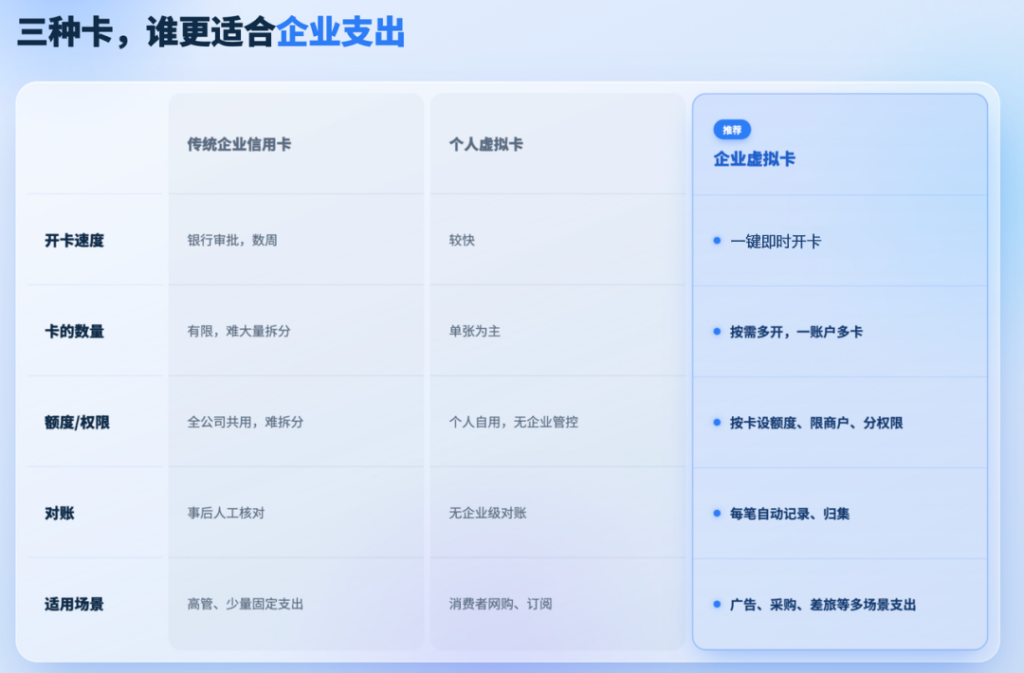
The advantages of corporate virtual cards are:
Quick card opening, detailed management, flexible permissions, and clear accounts.
It can help companies split and manage the originally chaotic overseas expenditures.
For example:
The marketing team is responsible for Facebook advertising and can configure advertising cards separately;
When the technical team purchases a server, the purchasing card can be configured separately;
The sales team can configure a travel card when traveling overseas.
Different businesses are managed independently, and finances can be calculated quickly.
Current situation: Common usage scenarios of enterprise virtual cards
1. Overseas advertising
For cross-border e-commerce, games, application promotion, and overseas marketing companies, advertising is usually one of the largest expenditure scenarios.
Advertising platforms such as Facebook, Google, and TikTok generate large amounts of deductions every day.
Enterprises can base on:
- Advertising account;
- Release area;
- Project Team;
- Consumption budget;
Create different virtual cards for management.
This can avoid the mixing of funds in multiple accounts and make it easy to check the actual investment status of each project.
For example:
One card for the US market;
One card for the European market;
Different advertising accounts are managed separately.
Budgets are clearer and risks are easier to control.
2. SaaS subscription and overseas software procurement
Overseas companies often need to use:
- CRM system;
- AI tools;
- Cloud services;
- Data analysis tools;
- Email Marketing Software.
These services are usually small in value but substantial in quantity.
If all accounts are linked to the same bank card:
- It is easy to forget to cancel the subscription;
- It is inconvenient to calculate costs;
- Automatic deductions are difficult to manage.
Enterprises can set up independent virtual cards for different suppliers and limit the amount according to budget.
When you need to stop using it, you can directly deactivate the corresponding card without affecting other businesses.
3. Overseas procurement and supplier payment
When companies purchase overseas services or products, they often require different payment methods.
Virtual cards can help businesses:
- Separate supplier payments;
- Control purchasing budget;
- Keep complete transaction records.
For cross-border teams, it can reduce personal advance payments and improve fund management efficiency.
4. Employee travel and project expenses
Overseas exhibitions, business inspections, team business trips and other scenarios often involve:
- Hotel;
- Transportation;
- Catering;
- Project costs.
Enterprises can assign virtual cards according to employees or projects.
Employees do not need to make frequent personal advances, and companies can also set budgets in advance to reduce financial management pressure.
5. Stable currency payment scenario
Some companies in supported areas can open virtual cards through stablecoin balances for online payments.
Transactions are still settled according to the card organization network, and enterprises can manage them uniformly:
- Card limit;
- Consumption records;
- Rules of Use.
Which overseas companies are suitable for using corporate virtual cards?
In fact, as long as a company has overseas payment needs, it can consider using corporate virtual cards.
Especially suitable for:
Cross-border e-commerce companies
Used for advertising, platform fees, and software subscriptions.
Overseas marketing team
Used for promotion expense management of Facebook, Google, TikTok, etc.
SaaS and Technology Companies
Used for overseas tool and cloud service procurement.
Companies that export games and applications overseas
For advertising and global operating expenses.
Foreign trade and international trade companies
Used for overseas supplier payments and business expense management.
The larger the enterprise scale, the more teams there are, and the more complex overseas expenditures are, the more obvious the management value brought by virtual cards will be.
Solution: How to choose a reliable enterprise virtual card service provider?
When choosing a corporate virtual card platform, it is not recommended to only focus on “whether you can open a card”.
What’s more important is the long-term usability.
1. Card opening ability
Pay attention to whether it supports:
- Quick card opening;
- Batch card opening;
- API interface access;
- Enterprise-level management.
For enterprises with large card needs, batch management capabilities are very important.
2. Expenditure management ability
Excellent platforms usually need to support:
- Single card limit setting;
- Consumption limits;
- Card freezing/deactivation;
- Permission management.
Help companies control risks in advance instead of dealing with problems later.
3. Reconciliation ability
One of the issues that companies are most concerned about is:
“Where is this money spent?”
Therefore support is needed:
- Real-time transaction records;
- Classification statistics;
- Project Management;
- Financial Reconciliation.
Reduce the time spent manually sorting out bills.
4. Stability and risk control capabilities
Enterprises have used it for a long time and are more concerned about:
- Payment stability;
- Risk control system;
- Service response speed;
- Compliance capabilities.
A stable and reliable platform is more important than simply low price.
Written at the end
With the global development of enterprises, overseas expenditure management has become an important part of enterprise operations.
The corporate virtual card is not just a payment tool, but a set of solutions to help companies manage overseas funds.
By issuing cards by scenario, managing by budget, and accounting by project, companies can make advertising clearer, procurement more standardized, and financial management more efficient.
Global business must not only make money back, but also spend every money clearly and in a controllable way.
Virtual Card
Original article by Virtual Card Reviews & Cross-Border Payment Guides. If republishing, credit the source: https://visaspay.com/en/what-is-an-enterprise-virtual-card-how-do-overseas-companies-manage-adverti/